
When you have an autoimmune disease like rheumatoid arthritis, lupus, or Sjögren’s syndrome, it’s not just the pain or fatigue that changes your life-it’s what you can no longer do. Buttoning a shirt. Carrying groceries. Standing long enough to cook a meal. These aren’t minor inconveniences. They’re losses that chip away at your independence. And here’s the truth: most people with autoimmune conditions don’t get the right kind of help early enough. That’s where rehabilitation and occupational therapy come in-not as last resorts, but as essential tools to keep you moving, doing, and living.
Studies show that 5-8% of people worldwide live with some form of autoimmune disease, and three times as many are women. By the time many seek help, they’ve already lost 20-40% of their functional ability. The Health Assessment Questionnaire Disability Index (HAQ-DI) measures this. A score above 1.5 means you’re struggling with daily tasks. A score above 2? You’re likely dependent on others for basic needs. The good news? Starting rehab within the first year of symptoms can improve your HAQ-DI score by 35-42%.
As inflammation settles, you move into aerobic training. Not high-intensity interval training. Not spinning classes. Think walking on a treadmill at 40-60% of your heart rate reserve. That’s about a slow, steady pace where you can still talk but not sing. Hydrotherapy-exercising in warm water (92-96°F)-reduces pain 22% more than land-based exercise. The water supports your weight, reduces joint pressure, and helps circulation. But here’s the catch: 68% of rural clinics don’t have underwater treadmills. That’s why home-based programs are growing fast.
Therapists use tools like goniometers to measure joint range and TENS units (delivering 50-100Hz pulses) to block pain signals. But the real magic? Progression. You don’t jump from resting to running. You go from seated leg lifts to standing balance drills to short walks, each step timed to your disease activity. A 2022 study from the Back to Motion database found PT improved lower-body function 28% more than OT alone. But PT alone doesn’t fix how you do daily tasks.
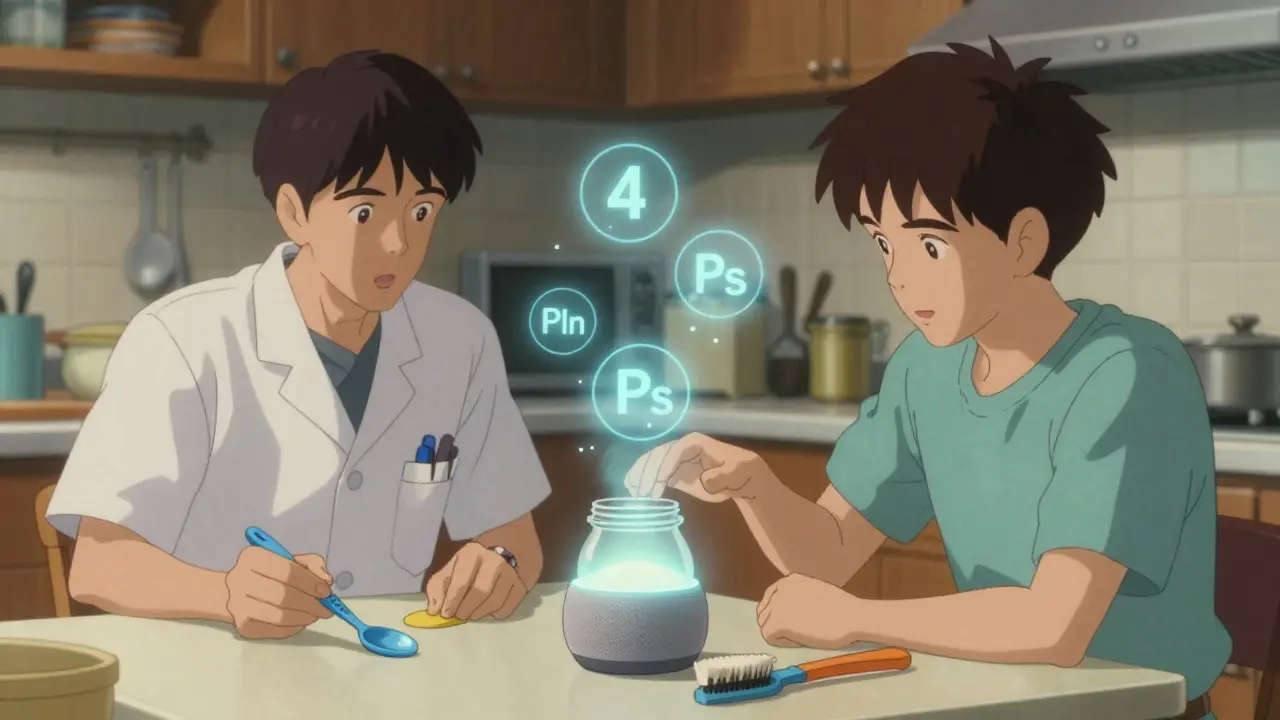
Therapists teach the 4 Ps: Prioritize, Plan, Pace, Position.
OT also brings in adaptive tools. Voice-activated smart home systems (like Alexa or Google Home) help people with hand weakness control lights, thermostats, and even door locks. One study showed a 31% increase in independence for those using these tools. Custom splints, weighted utensils, and rocker-bottom knives aren’t gimmicks-they’re lifelines.
OT outperforms PT in upper-body function. The Arthritis Hand Function Test shows OT improves grip, pinch, and fine motor skills 33% more than PT alone. That’s because OT doesn’t just build strength-it rebuilds coordination, timing, and strategy.
The Canadian Occupational Performance Measure (COPM) is the gold standard. Patients rate their ability to do key tasks on a 10-point scale. A 2-point increase? That’s clinically significant. It means you went from struggling to bathe yourself to doing it with minimal help.
Therapy intensity follows a stepped-care model:
Therapists need special training. The Academy of Pelvic Health Physical Therapy offers a 120-hour autoimmune certification. You’re not just getting any PT or OT-you’re getting someone who knows how lupus differs from scleroderma, how fibromyalgia fatigue differs from RA joint pain, and how to adjust for steroid-induced muscle loss.
37% of patients start with high-impact workouts-running, CrossFit, heavy lifting-and end up with injuries. One study found this increased injury rates by 23%. Another 19% of programs ignore central fatigue-the brain’s inability to send proper signals to muscles. This is huge in lupus and Sjögren’s. Pushing someone with central fatigue to “try harder” only makes them worse.
And then there’s the insurance problem. Most plans cover only 12-15 sessions per year. But the data says you need 24-30 to see lasting change. That leaves many patients stuck. Reddit threads from r/ChronicIllness are full of stories like: “My therapist pushed me to walk 30 minutes even though I was swollen. I crashed for 10 days.” That’s not rehab. That’s harm.
Failure often comes from mismatched pacing. Jumping from rest to high-intensity training too fast causes 29% of patients to flare. The solution? The 70% effort rule. Never push beyond 70% of what you think you can do. Leave 30% in the tank. Always.

Future protocols will use biomarkers. For example, serum IL-6 levels (a marker of inflammation) are now being used to adjust exercise intensity. A 2023 study showed patients who adjusted their workouts based on weekly IL-6 readings improved outcomes by 39%.
Apps are coming too. The Lupus Foundation’s “PacePartner” is in Phase 3 trials. It uses wearable sensors to track heart rate, movement, and sleep. Then it predicts flare risk with 82% accuracy. If it detects you’re heading toward a crash, it tells you to rest-not push.
Medicare raised reimbursement rates by 5.7% in 2024 for chronic condition rehab. That’s a win. But there’s a looming crisis: by 2026, the U.S. will be short 18,000 certified therapists. Access will become harder unless we train more.
Rehab isn’t about curing your disease. It’s about reclaiming your life. You don’t have to give up what matters to you. With the right support, you can still cook, work, hug your kids, and walk your dog-even if your immune system won’t quit.

Let’s cut the crap-rehab isn’t magic. It’s hard, boring, and often ignored by doctors who think ‘rest’ is a cure. I’ve seen people push through PT and crash for weeks. The 70% rule? That’s the only thing that works. Stop glorifying ‘pushing through.’ Your body isn’t a gym rat. It’s a fragile, inflamed mess that needs patience, not punishment.

I’m 32, have lupus, and started OT last year. I didn’t think I’d ever open a jar again. Now I use a rocker knife, sit while brushing my teeth, and Alexa turns on my nightlight. It sounds small-but it’s everything. Thank you for saying this out loud. 🙏

OMG I just cried reading this. I’ve been told to ‘just exercise more’ by my doctor and I’ve been in a cycle of boom bust for 3 years. The 70% rule changed my life. I’m not perfect but I’m finally not terrified of doing laundry. Thank you thank you thank you

Interesting piece. I’m in the UK and we’ve got access to NHS OT but the waiting list is 11 months. By then, you’ve lost so much mobility it’s hard to rebuild. Shouldn’t this be urgent care, not elective? Just saying.

Oh here we go. Another ‘rehab is the answer’ sermon. You know what fixes autoimmune disease? A functioning immune system. Not splints. Not voice assistants. Not treadmill walks at 40% HR. This is band-aid medicine for people too scared to face the real issue: we’re being poisoned by modern life. Gluten. EMFs. Vaccines. Fix the root. Stop coddling.

Wow. This is… surprisingly thoughtful. Not the usual ‘take a vitamin and call it a day’ nonsense. I’m impressed. The 70% rule? Genius. I’m a former CrossFit coach who went lupus-diagnosed last year. I used to tell people to ‘suck it up.’ Now I tell them: rest like it’s a sacred ritual. 🙌

As someone who trains therapists, I’ve seen too many get it wrong. The real problem? Insurance. Medicare pays $45 for a 30-min OT session. That’s not enough to train someone to use a long-handled brush. We need funding, not fluff. This article? Spot on.

Did you know the NIH registry is funded by Big Pharma? IL-6 tracking? That’s just a way to keep you dependent on drugs. The real solution is cold exposure, fasting, and herbal tinctures. I’ve been symptom-free for 4 years since I stopped ‘modern rehab.’ They don’t want you to know this.

Why are we even talking about this? In America, if you’re not rich, you’re screwed. My sister had to sell her car to pay for 12 sessions. Meanwhile, the VA gives veterans 50 sessions. Double standards. This isn’t healthcare. It’s a lottery.

It is with profound reverence and unwavering conviction that I submit this commentary: the paradigmatic shift in rehabilitative science, as elucidated herein, represents nothing short of a quantum leap in the ontological reclamation of human autonomy vis-à-vis autoimmune pathology. The integration of COPM metrics with stepped-care modalities, coupled with the emergent biomarker-driven protocols, constitutes a hermeneutic breakthrough of monumental, epoch-defining significance.

Here in India, we have no OT. My mom uses a wooden spoon with tape on the handle to eat. She can't lift her arm. No one tells her about pacing. She just cries. This article made me cry too. Thank you for seeing us.

Rehab works. But only if you’re not lazy. Most people just want a pill. They don’t want to sit and do 10 leg lifts. That’s why they’re still stuck.

I’ve been in remission for five years. I credit my occupational therapist who taught me to prioritize. I stopped doing laundry every week. I started using a shower chair. I stopped apologizing for resting. It wasn’t weakness. It was strategy. Small changes. Big freedom.

As a physiotherapist in Cape Town, I’ve seen the gap. We use adaptive tools made from recycled materials-plastic bottles as weighted utensils, rope handles for jars. No fancy tech. Just ingenuity. The 70% rule? Universal. No matter the country. No matter the currency.

I’m not convinced this isn’t just another corporate wellness scheme disguised as medical care. The ‘PacePartner’ app? Sounds like a data harvest tool. And why are they pushing IL-6? Because it’s profitable. I’ve seen too many ‘rehab’ programs that just lead to more prescriptions.