
Your list is currently empty. Start adding your medications above to create your safety record.
Keep this list in your wallet or give a copy to your healthcare provider.
Imagine you're in an emergency room or visiting a new specialist, and the doctor asks exactly what you're taking. It sounds simple, but for many of us, it's a blur of "the little blue pill for blood pressure" and "that vitamin I bought online." This kind of uncertainty isn't just frustrating-it's dangerous. According to the Centers for Disease Control and Preventiona national public health agency in the United States, medication issues lead to over 1.5 million emergency room visits every year. A simple, accurate personal medication list is the most effective tool you have to stop these avoidable mistakes before they happen.
When you move between a primary doctor, a cardiologist, and a dentist, your medical data doesn't always travel with you. In fact, the Agency for Healthcare Research and Qualitya federal agency that produces evidence to make healthcare safer found that inaccurate lists contribute to about 50% of all medication errors during care transitions. Whether it's a dangerous drug-drug interaction or a double dose because two doctors prescribed the same thing under different names, the risks are real.
For older adults, the stakes are even higher. Medications that affect the central nervous system-like certain sedatives or antidepressants-can increase the risk of falls by 50%. Having a list allows your pharmacist or doctor to spot these risks and adjust your dosage, potentially preventing a life-altering injury.
A common mistake is only listing prescriptions. However, Dr. Sarah Ahmed, a geriatric pharmacotherapy specialist, notes that omitting over-the-counter (OTC) drugs and supplements accounts for roughly 30% of unexpected adverse reactions. If it goes into your body, it goes on the list.
To make your list truly useful, you need more than just a name. Use these specific details for every entry:
| Category | What to Include | Example |
|---|---|---|
| Prescriptions | Generic/Brand name, dose, frequency | Lisinopril (Zestril), 10mg, 1x daily |
| OTC Drugs | Active ingredient, amount, usage | Acetaminophen (Tylenol), 500mg, as needed for pain |
| Supplements | Vitamin/Herb name, dose, source | Vitamin D3, 2000 IU, daily |
| Safety Data | Allergies and previous reactions | Allergic to Penicillin (hives) |
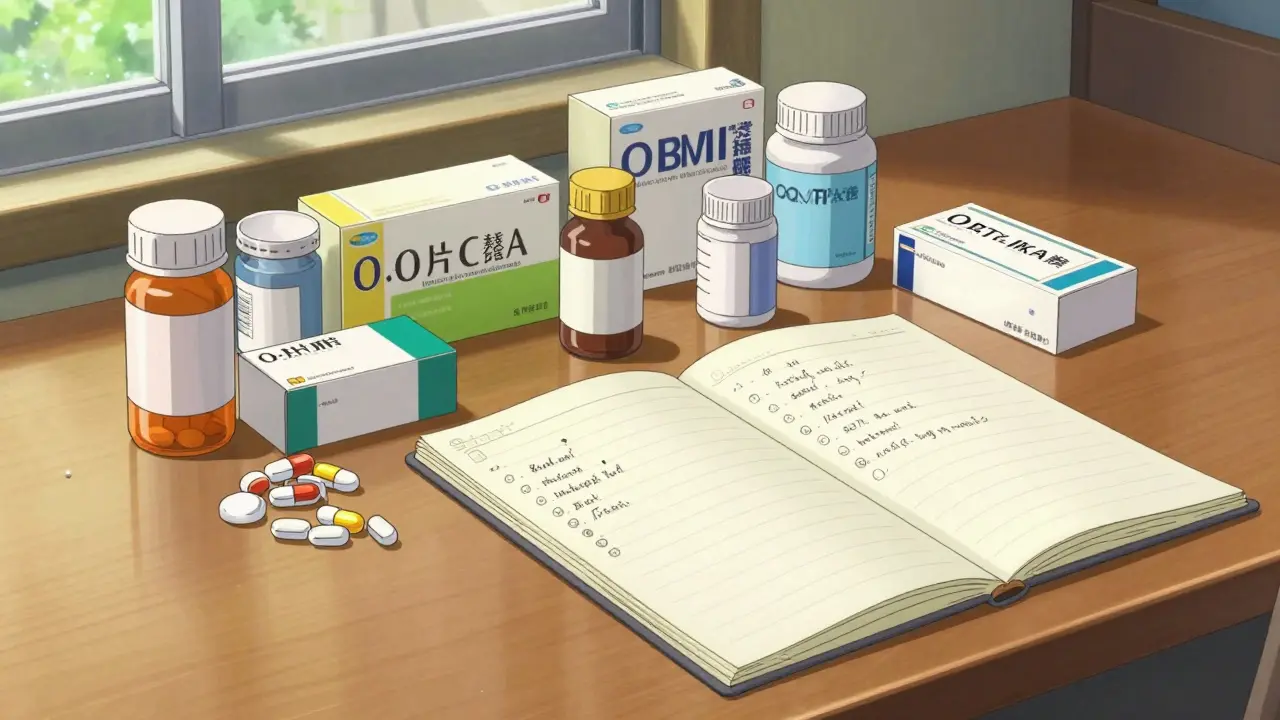
You don't need a medical degree to keep your records straight, but you do need a system. The U.S. Food and Drug Administrationthe federal agency responsible for protecting public health by ensuring the safety and efficacy of medications recommends a few different paths depending on your tech comfort level.
The Analog Approach: A simple paper list kept in your wallet is a lifesaver during emergencies. To avoid "polypharmacy" (taking too many unnecessary drugs), try writing the condition the drug treats directly on the bottle. This makes it obvious if you're taking two different pills for the same issue.
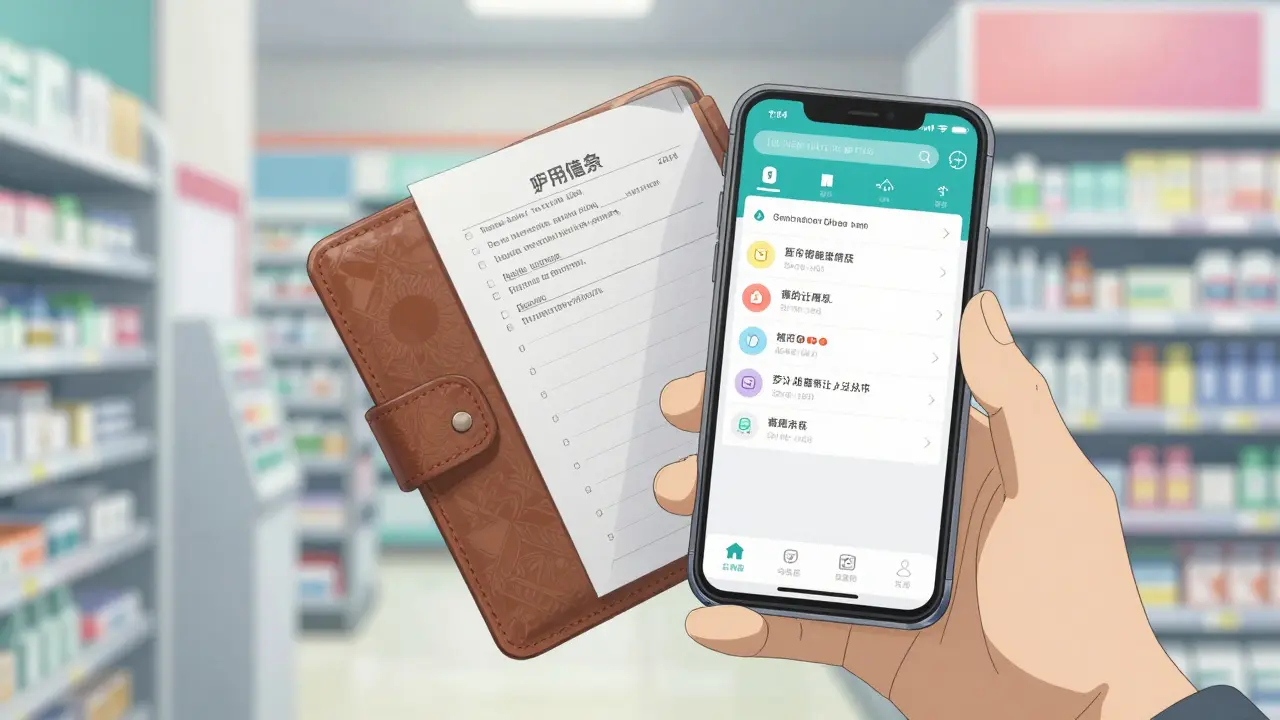
The Digital Approach: Smartphone apps can be game-changers. Recent data shows that 68% of patients using electronic trackers maintain more accurate records. New tools, like the MyMedSchedule app, even use photo recognition to identify pills from a picture, reducing documentation errors by over 60% in some patient groups.
The Pharmacy Strategy: One of the simplest ways to stay safe is to use a single pharmacy. When all your prescriptions go through one door, the pharmacist's system can automatically flag potential interactions. Patients using one pharmacy have seen a 37% drop in drug interaction incidents.
A medication list is only useful if it's current. An outdated list is almost as dangerous as no list at all, as 35% of medication discrepancies happen because of old information. Your list should be a living document.
Set a rule for yourself: update the list the moment a change happens. This includes:
Once updated, share this list with every health professional you see. This includes your dentist, your physical therapist, and any specialists. Many of these providers prescribe medications that can interfere with your primary treatments.
Yes. Many supplements interact with prescription drugs. For example, St. John's Wort can make some heart medications less effective, and Vitamin K can interfere with blood thinners. If it has an active ingredient, it belongs on your list.
The safest method is a dual approach. Keep a printed copy in your wallet or purse and a digital copy (like a photo or a dedicated app) on your phone. This ensures that if your phone battery dies or you lose your wallet, the information is still available to emergency responders.
You should review your list at every single appointment. Even if nothing has changed, a "medication reconciliation"-the process of verifying your list against the clinic's records-is a critical safety step to prevent errors.
Check the pharmacy label on the bottle or call your pharmacist. You can also use a pill identifier tool or a photo-recognition app to help identify the drug based on its shape, color, and imprint, then verify that information with a professional.
Absolutely. Including the prescribing physician's name and contact information helps your current doctor coordinate care and resolve any conflicting instructions quickly.
If you're just starting, don't try to do everything in one hour. Start by gathering every bottle and supplement in your house. Use a template from the FDA or a simple notebook to list them. Once you have the basics, call your primary pharmacist to verify the generic names and dosages.
If you're a caregiver, the best move is to implement a pill organizer alongside the list. This creates a double-check system: the list tells you what *should* be taken, and the organizer shows you what *was* taken. This combination can improve dosing accuracy by up to 45%.

This is such a great reminder for everyone! I always try to keep my list updated and it really does make those doctor visits go so much smoother.

Listen up! Stop playing around with your health and get your med-recon in order right now! If you aren't tracking your pharmacokinetics and potential contraindications with a rigorous system, you're basically gambling with your life! High-intensity focus on this today! Get a digital tracker, sync your cloud, and crush those errors before they crush you! No excuses!

Adding a section for the prescribing doctor's contact info is a huge pro tip. I've seen so many cases where a specialist needs to tweak a dose but can't get a hold of the primary physician for days, which just stalls the whole treatment process.
Also, for those using the analog method, I recommend laminating your list and taping it to the inside of your medicine cabinet or the back of your front door. That way, if paramedics arrive and you're incapacitated, they don't have to hunt through your wallet to find the critical data they need. It's a small step that can literally save a life in a crisis.

The point about St. John's Wort is particularly interesting because so many people assume herbal equals safe.

It is utterly catastrophic that the average citizen is forced to perform the basic duties of a pharmacist simply because the healthcare infrastructure is a fragmented disaster. One must marvel at the sheer incompetence of a system where a piece of paper is the primary defense against lethal drug interactions. Truly, we are living in a dark age of medical administration where the burden of safety is shifted onto the frail and the elderly. It is a tragedy of Shakespearean proportions.

Spot on. Just keep it simple and don't overthink it. Even a basic notes app on your phone does the trick for most of us.

I really appreciate the emphasis on including OTC meds!!! It's a common blind spot for many people!!! Definitely a life-saver to be thorough!!!

The suggestion to utilize a single pharmacy is quite prudent and ensures a higher standard of safety.