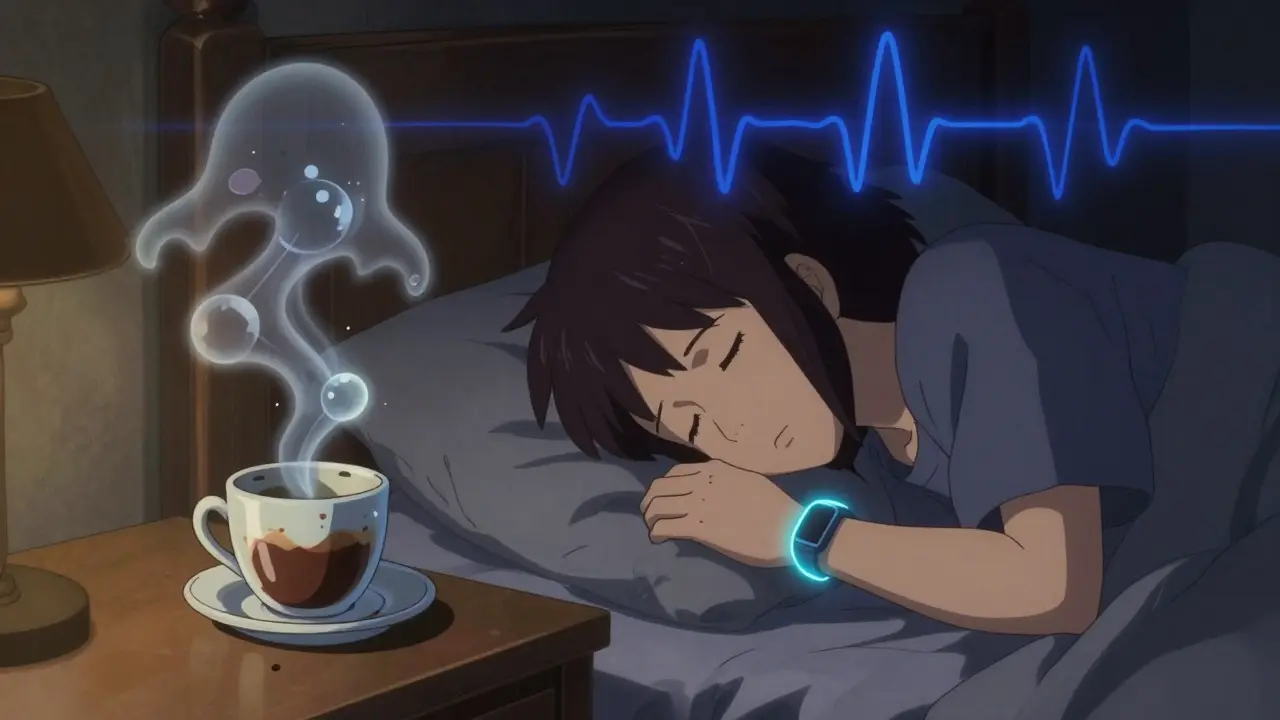
You fall asleep fine. You think you’re sleeping okay. But you wake up tired. Again. And again. If this sounds familiar, you’re not broken-you’re just drinking coffee too late.
Most people think if they can fall asleep after 6 p.m., caffeine isn’t a problem. But research shows that’s not true. Even if you drift off, your brain never fully shuts down. Caffeine lingers in your system, quietly stealing deep sleep, the kind that actually restores you. A 2022 review of 18 studies found that caffeine consumed just six hours before bed cuts total sleep time by 45 minutes and lowers sleep efficiency by 7%. That’s not a small drop. That’s a full night’s rest, eroded.
Caffeine doesn’t keep you awake by pumping you up. It doesn’t give you energy. It just blocks a signal your brain uses to tell you it’s tired.
Your brain makes a chemical called adenosine. As the day goes on, it builds up. When it binds to receptors, you feel sleepy. Caffeine is shaped almost exactly like adenosine. So it slips into those receptors first, like a fake key in a lock. No adenosine can get in. No sleep signal gets through. You feel alert-but your body is still tired. And when the caffeine finally wears off, all that built-up adenosine hits at once. That’s why you crash hard later.
It’s not about willpower. It’s biology. And your brain doesn’t lie.
For years, experts said stop caffeine six hours before bed. That’s what most people still follow. But newer research shows that’s not enough.
A 2021 analysis of 24 studies found that for a standard cup of coffee-about 107 mg of caffeine-you need an 8.8-hour cutoff before sleep to avoid measurable disruption. That means if you go to bed at 11 p.m., you should stop coffee by 2:12 p.m. That’s earlier than most people think.
And it gets worse if you’re drinking more than one cup. A double espresso? That’s 126 mg. A grande latte? Around 150 mg. A pre-workout powder? Some have over 200 mg. For those, you need 10 to 13 hours. Yes, that means if you take a pre-workout at noon, you’re still feeling its effects at midnight.
Black tea? Surprisingly, it’s less of a problem. It has less caffeine, and the way it’s absorbed slows things down. No hard cutoff time has been identified. But energy drinks? Avoid them after noon. Period.

Not everyone processes caffeine the same way. And it’s not just about how much you drink.
As you get older, your body slows down. A 2025 study in Nature Communications found that adults between 41 and 58 are significantly more sensitive to caffeine’s sleep-disrupting effects than people in their 20s. Your metabolism changes. Your brain becomes more vulnerable to interference.
And then there’s genetics. Some people have a gene variant called CYP1A2 that makes them slow metabolizers. Their bodies take up to 12 hours to clear half the caffeine. That’s double the average. If you’re one of them, even a morning coffee might mess with your sleep. You might not even know you’re a slow metabolizer-until you try cutting off caffeine at 2 p.m. and suddenly sleep like a baby.
Companies like 23andMe now offer genetic tests that tell you your caffeine metabolism type. If you’ve struggled with sleep for years despite “doing everything right,” it might be worth checking.
You think you’re being careful. You don’t drink coffee after 4 p.m. But you’re still getting caffeine from places you don’t even notice.
Excedrin? One tablet has 65 mg-almost two shots of espresso. Energy gels? Some have 100 mg. Chocolate? A 2-ounce bar of dark chocolate can have 40 mg. Even decaf coffee? It’s not zero. It has 2-5 mg per cup. That’s not much-but if you drink five cups, it adds up.
A 2023 survey by the Sleep Foundation found that 68% of people significantly underestimate caffeine in medications and snacks. You’re not lazy. You’re just misinformed.
Keep a log for a week. Write down everything you consume after noon. You’ll be shocked. That afternoon soda? That chocolate bar after lunch? That “herbal” tea that’s not herbal at all? All of it counts.
People who change their habits don’t just sleep longer-they sleep better.
A 2022 survey of over 2,000 users by Sleepopolis found that those who stopped caffeine by 2 p.m. (assuming a 10 p.m. bedtime) gained 47 extra minutes of sleep and saw an 8% jump in sleep efficiency. That’s not a minor tweak. That’s the difference between waking up refreshed and waking up groggy.
On Reddit’s r/sleep, one user wrote: “I switched from my last coffee at 4 p.m. to 2 p.m. and gained almost an hour of sleep quality. Eye-opening.” Another said, “I used to think I was a night owl. Turns out I was just wired on caffeine.”
And it’s not just anecdotal. A study of 15,328 sleep logs from the Sleep Cycle app showed that people who followed the 8-hour cutoff reported 82% satisfaction with their sleep quality. Those sticking to a 4-hour cutoff? Only 47%.

You don’t have to quit coffee. You just have to time it right.
One-size-fits-all advice is fading. In January 2025, the American Academy of Sleep Medicine announced they’re updating their guidelines to include beverage-specific cutoff times-not just “avoid caffeine late.”
Wearables like Oura Ring and Fitbit now offer personalized caffeine reminders based on your sleep data. If you consistently sleep poorly after afternoon coffee, they’ll nudge you. Philips SmartSleep is even testing systems that adjust your bedroom’s light and temperature based on when you last had caffeine.
And soon, your genetic profile might tell you exactly when to stop. If you’re a slow metabolizer, your cutoff might be 10 a.m. If you’re fast, maybe 4 p.m. is fine. Precision is coming. But you don’t need a DNA test to start.
You don’t need to overhaul your life. Just pick one change: stop coffee by 2 p.m. tomorrow. No exceptions. No “just one more.”
Track your sleep for a week. Notice how you feel in the morning. Are you waking up without an alarm? Are you less irritable? Do you feel like you actually rested?
If you’ve been told for years that you’re just a “light sleeper,” it might not be you. It might be the coffee you drank at 3 p.m.
Sleep isn’t about willpower. It’s about chemistry. And you control the chemicals you put in your body.
For a standard cup of coffee (about 107 mg of caffeine), stop drinking it 8.8 hours before bedtime. If you go to sleep at 11 p.m., cut off coffee by 2:12 p.m. Most people round this to 2 p.m. for simplicity. If you drink espresso, energy drinks, or pre-workout supplements, you’ll need to stop even earlier-sometimes as early as 8 a.m.
Decaf coffee still contains 2-5 mg of caffeine per cup. For most people, that’s not enough to disrupt sleep unless you drink five or more cups in the afternoon. But if you’re a slow metabolizer or extremely sensitive, even small amounts can add up. If you’re struggling with sleep, try switching to herbal tea after noon instead.
Black tea has less caffeine than coffee-about 40-70 mg per cup-and is absorbed more slowly. Research hasn’t identified a strict cutoff time for black tea, and many people tolerate it well in the early afternoon. Green tea has even less. But if you’re sensitive, or drinking multiple cups, it can still interfere. When in doubt, switch to herbal tea after 2 p.m.
Caffeine doesn’t stop you from falling asleep-it stops you from getting deep, restorative sleep. You might fall asleep easily, but your brain never enters the slow-wave and REM stages properly. That’s why you wake up tired, even after 8 hours. A 2022 review found caffeine reduces sleep efficiency by 7%, meaning you’re spending more time awake in bed without realizing it.
Yes-but they’re rare. A small percentage of people have a genetic mutation that lets them metabolize caffeine very quickly. But most people who think they’re fine are wrong. Studies show that even those who don’t notice sleep disruption still have reduced sleep quality. The brain doesn’t lie. If you’re getting less than 7 hours of restful sleep, caffeine is likely part of the problem-even if you don’t feel it.
Many over-the-counter pain relievers like Excedrin contain 65 mg of caffeine per tablet-more than a can of soda. Energy gels and protein bars often have 50-100 mg. These are hidden sources. If you’re taking them in the afternoon, you’re still getting caffeine. Check labels. If it says “caffeine” or “anhydrous caffeine,” treat it like coffee.
The average half-life is 4-6 hours, meaning half the caffeine is cleared from your blood in that time. But for slow metabolizers-about 50% of people-it can take up to 12 hours. That’s why some people can’t drink coffee after noon without wrecking their sleep. Genetics, age, and liver health all affect how fast your body processes it.
For many people, yes. Caffeine is one of the most common causes of poor sleep-and one of the easiest to fix. Studies show that simply stopping afternoon caffeine improves sleep efficiency, increases total sleep time, and reduces nighttime awakenings. It’s not a cure-all, but it’s the first step most people should take before trying supplements or sleep aids.

OMG I JUST REALIZED I’VE BEEN DRINKING ESPRESSO AT 5 PM AND WONDERING WHY I WAKE UP AT 3 AM 😭 switched to herbal tea at 2 pm and now I’m actually sleeping like a baby. Thank you for this.

This is such a reductive biohacking fantasy. You’re attributing complex neurophysiological phenomena to a single molecule while ignoring circadian entrainment, light exposure, and psychosocial stressors. Caffeine isn’t the villain-it’s the scapegoat for a society that outsources rest to pharmacology.

i tried stoppin coffee at 2pm and i swear i felt like a new person. used to be groggy all day now i dont need naps. also i had no idea decaf had caffeine?? wow. thanks for the info.

The paradox of modern consciousness: we seek optimization through chemical manipulation while simultaneously denying the biological rhythms that predate caffeine. The 8.8-hour cutoff is not a rule-it is an invitation to re-encounter our own physiology.

If you are serious about sleep hygiene you will eliminate all caffeine after noon without exception. No compromises. No exceptions. Your health is non negotiable.

This is legit the most helpful thing I’ve read all year 🙏 I used to think I was a night owl but turns out I was just addicted to my own nervous system. Started cutting off at 2pm and now I’m waking up naturally at 6:30am. No alarm. No coffee. Just peace. 🌅

You people are pathetic. You think stopping coffee at 2pm is some kind of achievement? I’ve been sleeping 8 hours since I was 16 while drinking espresso at midnight. You’re not broken-you’re weak. Stop blaming caffeine and start building discipline.

Caffeine’s molecular mimicry of adenosine is a poetic tragedy-our own neurochemistry hijacked by a bean. But let’s not forget: the real poison isn’t the compound, it’s the illusion of control. We drink to feel awake, but we’re just delaying the inevitable collapse of our circadian rhythm.

To everyone saying they’re fine with late coffee-please, take a sleep tracker for a week. You might not feel the damage, but your REM cycles are screaming. I used to be skeptical too. Then I tracked my sleep for 30 days after cutting off at 2pm. My deep sleep went from 12% to 24%. Life-changing. You don’t need a DNA test to start. Just try it.

The 8.8-hour cutoff is statistically insignificant when you consider individual variability. This is peak wellness culture pseudoscience-quantified self delusion dressed up as biology. If you’re sleeping poorly, maybe your mattress is trash, your room is too bright, or you’re scrolling TikTok until 2am. Blaming caffeine is lazy.

I’ve been studying chronobiology for 17 years and let me tell you-this whole 8.8-hour thing is a gross oversimplification. The half-life of caffeine varies wildly based on oral contraceptives, smoking status, liver enzyme activity, and even gut microbiome composition. You can’t reduce human physiology to a single time stamp. And yet here we are, people treating caffeine like it’s a moral failing. It’s exhausting.

Oh wow so I’m just supposed to stop drinking coffee because some study says so? What’s next? You’ll tell me to stop breathing oxygen at 8pm because it might interfere with my REM cycle? 🤡

I’ve been reading this whole post and I’m just… tired. Tired of people treating sleep like a puzzle you solve with caffeine cutoffs. It’s not a hack. It’s a lifestyle. And if you need a chart to tell you when to stop drinking coffee, maybe you’ve already lost the battle.