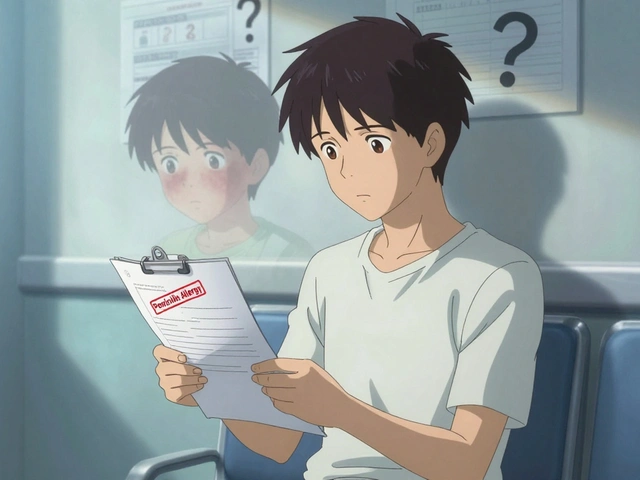

Every year, millions of people are told they’re allergic to penicillin-or another common drug-based on a rash they got as a child, a stomach ache after a pill, or a reaction they heard about from a friend. But here’s the truth: 90% of people who think they’re allergic to penicillin aren’t. That’s not a guess. It’s what the CDC and top allergy clinics have confirmed after testing thousands of patients. Mislabeling a drug allergy doesn’t just cause inconvenience-it can put your health at risk, cost you more money, and even lead to worse infections.


Yes, many people outgrow penicillin allergies, especially if the reaction happened in childhood and wasn’t severe. Studies show that over 80% of people who had a mild reaction more than 10 years ago no longer react to penicillin. The immune system changes over time, and what was once a trigger may no longer be. Testing is the only way to know for sure.
No. Many rashes that appear after taking antibiotics-especially amoxicillin-are not allergic reactions. In children with viral infections like mono, a rash can develop even if they’re not allergic. True allergic rashes are usually itchy, raised, and appear within hours of taking the drug. Non-allergic rashes are often flat, not itchy, and may appear days later. A doctor or allergist can help tell the difference.
Yes, most insurance plans in the U.S. and U.K. cover penicillin allergy testing when recommended by a doctor. Skin tests and oral challenges are considered medically necessary when there’s uncertainty about the allergy. The cost is typically under $200 out-of-pocket, and it often pays for itself by avoiding more expensive antibiotics later.
It’s possible, but rare. Penicillin, amoxicillin, and ampicillin all share the same core structure, so if you’re allergic to one, you’re likely allergic to the others. However, some people react to additives or fillers in a specific brand, not the active ingredient. That’s why testing focuses on the drug class, not individual brands. Always confirm with an allergist before assuming safety.
Stop taking the medication immediately. If you have trouble breathing, swelling in your throat, or dizziness, call emergency services. For milder reactions like a rash or itching, contact your doctor. Don’t assume it’s harmless. Write down the name of the drug, when you took it, and exactly what happened. This helps your doctor determine if it’s an allergy or a side effect-and prevents future mistakes.
Yes. Penicillin and sulfa drugs are completely different chemically. Being allergic to one doesn’t mean you’re allergic to the other. Sulfa allergies are separate and less common. But if you’ve had a reaction to a sulfa antibiotic like Bactrim, you should avoid all sulfa drugs unless cleared by an allergist.
Bring your allergy test results with you-even if they’re old. Say: “I was told I was allergic to penicillin, but I was tested and cleared in [year]. Here’s the documentation.” Ask them to update your chart. If they don’t, ask to speak to the medical records department. Your safety depends on accurate records, and you have the right to correct them.

penicillin allergy is a myth lol i was told i was allergic as a kid for a rash and now i take amoxicillin like candy

This is so important. I had a mild rash at 7 and spent 20 years avoiding penicillin-until I got tested last year. Turned out I was fine. Saved me thousands and kept me from getting C. diff after surgery. If you think you're allergic-get tested. Your body will thank you.

My mom got cleared last year after 40 years of being labeled allergic. She cried. She said she finally felt like she could trust her own body again.

The healthcare system is still stuck in the 1980s. I’ve seen charts with "penicillin allergy" scribbled in pencil from 1992, never updated. Meanwhile, patients are getting vancomycin for sinus infections because no one bothered to ask, "Did you actually have an allergic reaction?" It’s not negligence-it’s systemic laziness. And it’s killing people quietly.
My cousin got C. diff after a routine dental procedure because they couldn’t use penicillin. She spent three weeks in the hospital. The doctors never even mentioned testing. She was 22. She’d never had a serious reaction. Just a red spot on her arm when she was six.
We need mandatory allergy re-evaluation protocols. Not optional. Mandatory. Like vision tests for drivers. You wouldn’t let someone drive with blurry vision for decades-you shouldn’t let them take dangerous antibiotics because of a childhood rash.
And don’t get me started on how pharmacies auto-flag these allergies in their systems. Even if you bring in documentation, they still ask you to sign a waiver. Like you’re trying to poison yourself.
This isn’t just about antibiotics. It’s about how we treat patient history. We treat it like a sacred text, not a living document. And that’s dangerous.
Doctors don’t want to admit they were wrong. Pharmacies don’t want to change their algorithms. Insurance companies don’t want to pay for testing. So patients suffer.
But you? You can change it. Bring your test results. Demand updates. Send letters. Call the medical records department. Don’t let a label from your childhood dictate your treatment in your 40s.
I’ve seen too many people die because they were denied the right drug. This isn’t theoretical. It’s happening right now. To someone you know.

Penicillin’s beta-lactam ring structure is the key determinant of cross-reactivity, not the side chain-this is well-documented in the 2021 JACI guidelines. Cephalosporin cross-reactivity is actually closer to 2-5% in true IgE-mediated cases, not the outdated 10% myth perpetuated by EMRs.
Moreover, the concept of "outgrowing" is misleading-it’s not that the immune system forgets, but that IgE titers decay over time, especially in non-anaphylactic exposures. Skin testing remains the gold standard for reclassification.

I never knew this. I thought if you were allergic once, you always were. I’m going to ask my doctor about testing-I’ve been avoiding penicillin since I was 8. This could change everything.

So what you’re saying is, doctors are too lazy to update records, and we’re all just guinea pigs for their bad habits? Cool. I’ll just keep dying quietly then.

My husband was told he was allergic to penicillin after a rash at age 5. He’s 41 now. Last year, he got tested and was cleared. He’s been on amoxicillin twice since-no issues. He says it felt like being freed from a prison he didn’t even know he was in.
It’s not just about the drug. It’s about the fear. The stigma. The assumption that your past defines your future. That’s the real illness.

If you’ve ever been told you’re allergic to penicillin, please, for the love of all that’s medical-get tested. Not because I said so. Not because the CDC said so. But because you deserve to know the truth about your own body.
That rash you had as a kid? Probably viral. That stomach ache? Probably the antibiotic killing your gut flora. That dizziness? Probably dehydration.
You’re not broken. You’re misinformed. And that’s fixable.
Don’t wait for your doctor to bring it up. Bring it up yourself. Print this post. Take it to your appointment. Say: "I want to be tested. I think I might have been misdiagnosed."
It takes two hours. It costs less than a dinner out. And it could save your life.
You’ve survived 10, 20, 30 years thinking you were allergic. Now give yourself the chance to be free.

Of course the system is broken. Big Pharma doesn’t want you taking cheap, effective penicillin-they want you on their expensive, patented antibiotics. The CDC? They’re just the front for the pharmaceutical lobby. They’ve been pushing this "90% aren’t allergic" narrative for years. Why? Because it makes more money for hospitals and pharmacies to prescribe vancomycin and clindamycin. You think this is about your health? It’s about profit.
And don’t even get me started on how electronic records are controlled by corporations that refuse to update your file unless you pay $200 to "appeal" it. This isn’t medicine-it’s a scam.

I’m from Singapore, and we’ve had public awareness campaigns about this since 2018. The National Healthcare Group here runs free penicillin testing clinics in community centers. Over 60% of people who get tested turn out to be fine. It’s normalized here. Why can’t the U.S. do the same?
It’s not just about drugs. It’s about trust in the system. When people don’t trust their doctors to get things right, they stop asking questions. And that’s when things get dangerous.

There is a deeply disturbing pattern here: the medical establishment has institutionalized the myth of the penicillin allergy as a form of medical inertia. This is not a failure of individual practitioners-it is a systemic pathology rooted in risk-averse protocols, liability avoidance, and the commodification of patient identity. The label becomes a bureaucratic artifact, detached from biological reality. The patient’s lived experience is overwritten by algorithmic certainty.
When your medical record becomes your prison, and your body becomes a data point, we have moved beyond negligence into the realm of epistemic violence. The patient is no longer sovereign. The record is.
And yet, the solution is not more testing. It is the dismantling of the entire paradigm that reduces human physiology to a static, unchangeable database entry.
What if we stopped labeling people entirely? What if we treated every reaction as a unique event-not a lifelong sentence?

Man, I used to be scared of penicillin too. Then I got my kid sick with strep throat and the doc said "try amoxicillin." I said "no way, he’s allergic." Then I looked up the stats. 90% of people aren’t actually allergic. So I let him take it. No reaction. He’s fine. Now I’m mad I wasted 15 years being scared. America needs to get smarter about this stuff.

Wait-so you’re telling me that the entire U.S. healthcare system is built on a 90% false positive? That’s not a flaw-that’s a collapse of diagnostic logic. If 9 out of 10 people are misdiagnosed, then the diagnostic criteria themselves are invalid. Why are we still using them? Who approved this? What institutional incentives keep this myth alive? And why is no one being held accountable?
This isn’t a medical issue. It’s a failure of epistemology. We’ve institutionalized ignorance.
Thank you for this. I’m an allergist. I’ve done over 2000 penicillin tests in the last decade. Less than 5% of people who think they’re allergic actually are. Most of them are terrified to get tested because they’ve been told for decades that it’s dangerous. But the truth? The test is safer than taking a random antibiotic you don’t need.
And yes-I’ve seen patients cry when they find out they were never allergic. They say, "I didn’t realize I could breathe normally again."
Don’t let fear keep you from the truth.
so if you’re allergic to penicillin you can still take cephalexin right? just asking