Select an SSRI and your metabolic status to see your dose adjustment recommendations
When someone starts taking an SSRI like Lexapro, Zoloft, or Prozac, they often hope for relief from depression or anxiety. But for many, the first weeks bring more than just hope-they bring dizziness, nausea, insomnia, or worse. About 30-50% of people on standard antidepressant doses experience side effects severe enough to make them quit. What if part of the problem isn’t the drug itself, but how your body handles it?


It’s not magic. But it’s science-and it’s already helping thousands.

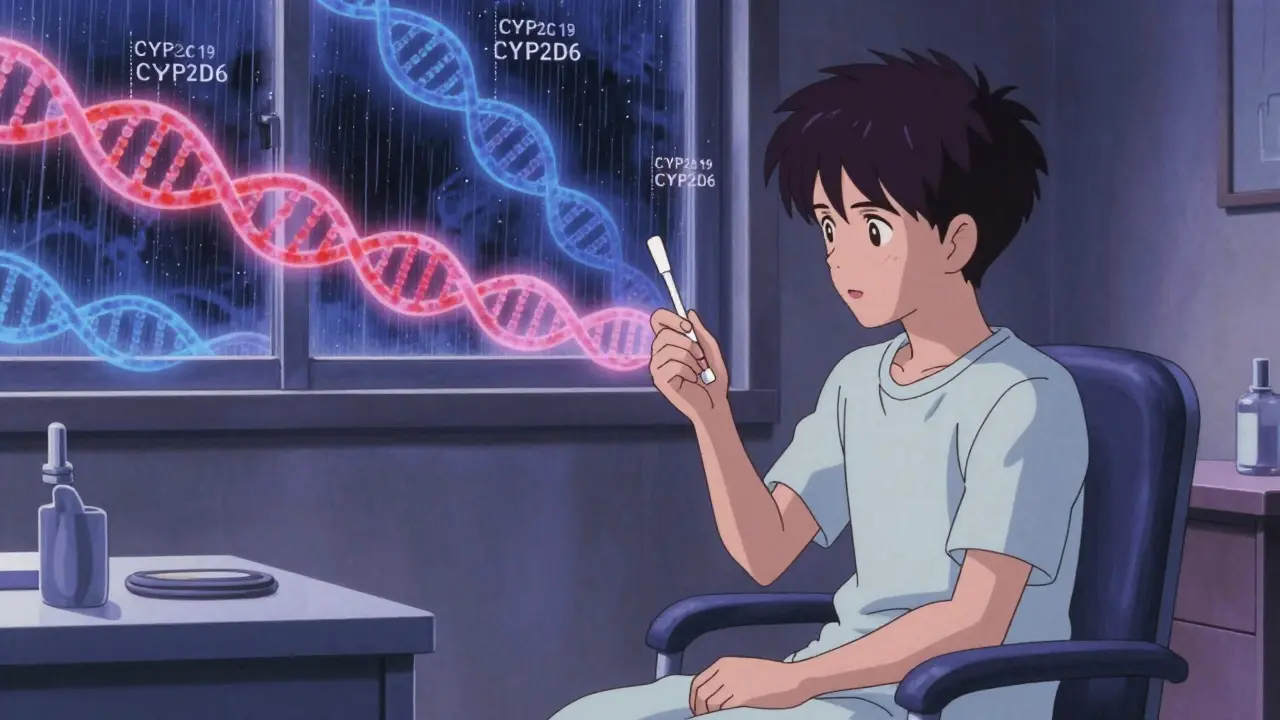
Been on Lexapro for 3 years. First time I tried 10mg, I felt like I was underwater and couldn’t think. Second time, I dropped to 5mg and it was fine. Turns out I’m a CYP2C19 poor metabolizer. No one told me this could be genetic. This post finally explains why I felt like crap for months.
Still, I’m not sure I’d pay $500 for a test unless my doctor pushed it. But now I know to ask.

Oh, so THAT’S why I went from ‘mildly anxious’ to ‘horrified raccoon’ on 20mg of Zoloft? I thought I was just a walking disaster.
Turns out I’m a CYP2D6 ultrarapid metabolizer. My doctor said ‘try harder’ for 18 months. I’m not a hero. I’m a biochemistry experiment gone wrong.
Now I’m on 75mg of sertraline and feel… normal? Like, human? Who knew? This test should be standard. Like a blood type. Not a luxury for people who can afford to suffer first.

The assertion that pharmacogenomic testing ‘makes antidepressants tolerable’ is a gross oversimplification. The literature demonstrates that CYP2C19 polymorphisms account for approximately 28–37% of interindividual variability in escitalopram clearance, not ‘the root cause’ of side effects.
Moreover, the CPIC guidelines themselves acknowledge that clinical outcomes are confounded by polypharmacy, adherence, and epigenetic modulation. To reduce psychiatric care to a single enzymatic pathway is reductionist at best, dangerous at worst.
Furthermore, the assertion that 23andMe ‘misses structural changes’ in CYP2D6 is technically inaccurate-its SNP-based approach captures >90% of common variants; it’s the *interpretation* that’s flawed, not the platform.

People are still dying because doctors don’t test this. My sister took Prozac, got seizures, spent a week in ICU. They called it ‘idiosyncratic reaction.’ It wasn’t. It was genetics. And now she’s on disability.
This isn’t science. It’s negligence. Stop pretending this is optional.

I’ve been doing this for 15 years. I’ve seen patients on 100mg of fluoxetine because they’re UMs, and their doctors just kept doubling the dose like it’s a video game. One guy ended up in the ER with serotonin syndrome because his psychiatrist thought ‘more is better.’
Then there’s the flip side-people on 2.5mg of escitalopram because they’re PMs, and their doctor says ‘maybe it’s not working, try something else.’ No. Try lowering the dose.
And don’t get me started on how insurance refuses to cover this unless you’ve tried five drugs and lost three jobs. It’s a profit-driven system. They want you to suffer first. Then they’ll pay for the fix.
I had a patient last month who found out she was a CYP2D6 PM after her third hospitalization. Her husband cried. He said, ‘We thought she was just weak.’ She wasn’t weak. She was genetically mismanaged.
Doctors need training. Pharmacies need to flag these. Insurance needs to stop being greedy. And patients need to demand this like it’s a right. Because it is.

My cousin got tested after trying four antidepressants. Turned out she was a CYP2C19 poor metabolizer. Dose cut in half. Side effects vanished. Mood stabilized. She’s working again, sleeping through the night, even started painting.
It’s not a miracle. It’s just… logic. Why do we test for blood sugar but not for how your body handles medicine?
Also, the 23andMe thing is real. My mom did one. Thought she was ‘normal.’ Turned out she had a rare CYP2D6 duplication. Only a targeted test caught it.
Ask your doc. If they don’t know what CPIC is, find someone who does.

So now we’re doing DNA tests so you don’t have to feel bad about being lazy? I’m sick of this ‘your body is broken’ narrative. You’re not a robot. You’re a human. Maybe you just need to eat better, sleep more, get outside.
My grandpa took Tofranil in ‘78 and never complained. No gene test. No fancy lab. Just grit.
Now we’ve got millennials crying because their serotonin levels aren’t perfect. This is why America’s falling apart. We outsource responsibility to our DNA.

They’re not testing your genes. They’re testing your loyalty to Big Pharma.
The real reason they push this is so you keep buying drugs. If you’re a poor metabolizer, you’ll need more pills. If you’re ultrarapid, you’ll need a new one every year. It’s a subscription model.
And don’t believe them about ‘saving money.’ The labs charge $500. The insurers pay $200. The drug companies make $12,000 per patient over 5 years.
CPIC? DPWG? All funded by pharma. The FDA adds warnings so they can sell more tests.
It’s not science. It’s a racket. And you’re the product.