

When you pick up a generic inhaler, patch, or injection, you expect it to work just like the brand-name version. But getting there isn’t as simple as copying a pill formula. For oral drugs, bioequivalence means checking if the active ingredient reaches your bloodstream at the same speed and amount. For inhalers, patches, and injections, that’s only part of the story. The real question is: does the drug get to the right place in the right amount-and does the device delivering it behave the same way every single time?
The FDA, EMA, and other regulators didn’t always require this level of detail. Back in the 1980s, the Hatch-Waxman Act made it easier to approve generic pills by comparing blood levels. But as more complex delivery systems hit the market-like asthma inhalers, nicotine patches, and long-acting insulin injections-it became clear that measuring plasma concentrations alone wasn’t enough. A generic albuterol inhaler might release the same amount of drug as the brand, but if the particle size is off by a few micrometers, or the plume temperature is 2°C higher, the drug might not reach deep into the lungs. That’s not bioequivalence. That’s a risk.
For metered dose inhalers (MDIs) and dry powder inhalers (DPIs), the delivery device is as important as the medicine. The FDA’s 2022 guidance says you can’t approve a generic inhaler based on blood tests alone. You need to prove three things: particle size, delivered dose, and how the drug moves out of the device.
For in vivo testing, regulators sometimes skip blood tests entirely. If the inhaler is meant to act locally in the lungs-like a corticosteroid-they’ll look at lung function instead. Did FEV1 (a measure of how much air you can blow out) improve the same way? That’s more meaningful than a blood draw.
And here’s the kicker: a 2021 review found only 38% of generic inhalers get approved. That’s the lowest success rate among all complex generics. Why? Because one small change in the propellant, valve, or canister can throw off the whole delivery system. A Reddit user shared that their company’s generic albuterol was rejected because the plume temperature was 2°C higher than the brand. That’s not a typo. Two degrees. And it was enough to fail.
Patches are designed to release drug slowly through the skin over hours or days. That’s great for nicotine, estrogen, or pain meds like fentanyl. But it makes bioequivalence tricky. Traditional Cmax (peak blood level) doesn’t mean much here-you’re not looking for a spike. You’re looking for consistency.
The FDA’s 2011 guidance says you need to prove:
For AUC (total exposure), the standard 80-125% range still applies. But Cmax? Sometimes it’s ignored. The FDA accepts reference-scaled bioequivalence for highly variable drugs like fentanyl patches, meaning the limits can widen if the brand itself has a lot of natural variation.
Approval rates are better than inhalers-52%-but still lower than pills. Why? Because skin absorption isn’t predictable. One person’s skin might absorb 30% more than another’s. That’s why regulators demand multiple subjects and long study periods. Teva’s generic nicotine patch, approved in 2020, took 4 years and 12 formulation tweaks to get right.
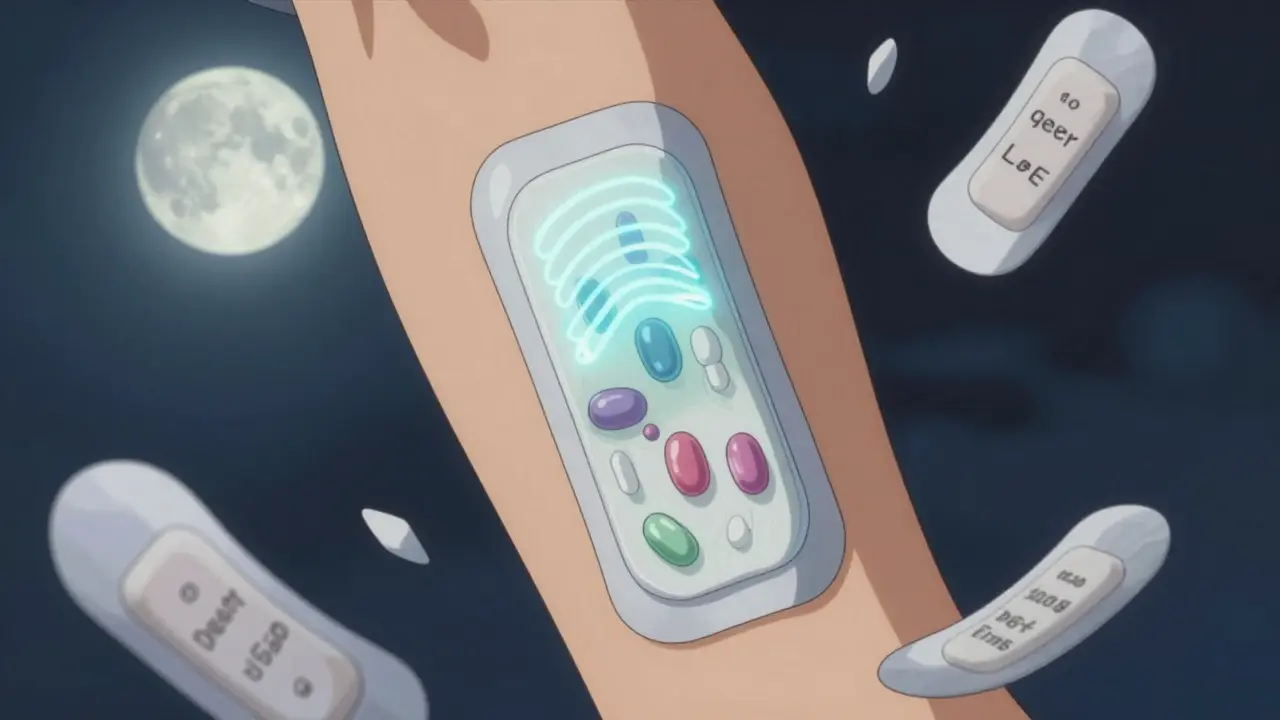
Not all injections are the same. A simple saline solution? Easy. A liposomal doxorubicin or nanoparticle-based insulin? That’s a whole different ballgame. These aren’t just drugs in a syringe-they’re engineered structures.
The FDA’s 2018 guidance says you need to prove:
And then there’s the device. A generic version of Bydureon BCise-a once-weekly auto-injector for diabetes-was rejected in 2021 because the injector mechanism didn’t deliver the drug the same way. The needle speed, pressure, and timing were slightly off. The drug was chemically identical. But the delivery? Not the same. The sponsor lost $45 million.
Complex injectables have a 58% approval rate. Still low. Why? Because manufacturing these particles consistently at scale is incredibly hard. One batch might have slightly larger particles. That’s enough to fail a regulatory audit.
Developing a generic pill might cost $5-10 million and take 18-24 months. For an inhaler, patch, or complex injection? It’s $25-40 million and 36-48 months. Why?
And even then, you might fail. A formulation scientist on the American Pharmaceutical Review forum spent $32 million and 42 months on a generic insulin glargine. They had to run 17 different formulations just to get the particle size right.

Only 28 companies have successfully brought complex generics to market. Teva leads with 14 approved products, followed by Mylan and Sandoz. These are giants with deep pockets and global labs.
Small companies? They’re struggling. But the FDA’s Complex Generic Drug Product Development program has helped 42 small businesses since 2018 with free consultations and technical guidance. Still, the bar is high.
Market adoption is slow. Even though complex delivery systems make up 30% of prescriptions, they only account for 15% of the generic market by value. Why? Because they’re expensive to make, so they’re expensive to sell. And patients often stick with the brand-especially if their insurance doesn’t push the generic.
But that’s changing. The global market for complex generics is projected to hit $112.6 billion by 2027. Why? Because big drugs like Humira and Stelara are losing patent protection. When that happens, the pressure to bring down costs will force more generics into play.
Regulators are starting to use new tools. In 2022, 65% of complex generic submissions included physiologically-based pharmacokinetic (PBPK) modeling-software that simulates how the drug behaves in the body based on physics and biology, not just blood samples.
The EMA is now requiring patient training materials as part of inhaler equivalence. After all, if the patient doesn’t inhale correctly, no generic will work.
There’s also a growing fear of “biocreep”-where multiple generations of generics, each slightly different, slowly drift away from the original. One study warned that after five or six generations, the cumulative differences might affect safety.
The Global Bioequivalence Harmonization Initiative is pushing for global standards. But for now, each region has its own rules. What works in the U.S. might not fly in Europe.
One thing’s clear: bioequivalence for special delivery systems isn’t about matching a number. It’s about matching a whole system-the drug, the device, the patient’s behavior, and the environment. And that’s why it’s harder. But it’s also why it’s necessary.
When a generic inhaler doesn’t deliver properly, patients don’t just get less relief-they might end up in the ER. When a patch leaks or falls off, pain returns. When an injectable particle size changes, the immune system might react.
Regulators don’t approve these products lightly. They’ve seen what happens when shortcuts are taken. That’s why they demand more. It’s not red tape. It’s protection.
Patients deserve generics that work as well as the brand. But they also deserve to know that the science behind them isn’t just a copy-it’s a carefully engineered replica. And that takes time, money, and precision.

The particle size requirements for inhalers are insane-90% of particles between 1 and 5 micrometers? That’s not just precision, that’s quantum-level manufacturing control. And yet, regulators expect this to be replicated by generic manufacturers with a fraction of the R&D budget. It’s not about cutting corners; it’s about whether the system can even be duplicated without the original proprietary tech.

What’s fascinating is how bioequivalence has evolved from a pharmacokinetic metric to a systems engineering problem. We’re no longer measuring drug concentration-we’re measuring the behavior of a device interacting with human physiology. It’s like trying to replicate a symphony by only matching the sheet music, ignoring the acoustics of the hall, the conductor’s tempo, and the musicians’ breath.

Okay but imagine being a patient who’s been on the same inhaler for 10 years and then gets switched to a generic that just… doesn’t feel right? You don’t know why. You don’t have the science. You just know your lungs aren’t opening up like they used to. And then you’re told it’s ‘bioequivalent.’ That’s not reassuring. That’s terrifying. We need better transparency-not just regulatory approval, but real-world feedback loops.
Also, props to the FDA for not letting this slide. This isn’t bureaucracy. This is keeping people alive.

My cousin’s a respiratory therapist and she swears by brand-name inhalers-even when generics are cheaper. She says the difference isn’t always measurable in a lab, but it’s *felt* in the clinic. Patients report better control, fewer rescue puffs, less anxiety. That’s real data. Maybe we need more patient-reported outcomes in approval protocols, not just plasma concentrations and plume geometry.

Let’s be real-this whole ‘bioequivalence’ thing is a smokescreen. The real reason generics for inhalers and patches are so expensive to develop is because Big Pharma wants to keep their monopoly. The FDA is just playing along. If it were truly about safety, why aren’t they requiring the same level of scrutiny for every single oral drug? No, this is about profit. And the patient? They’re the one paying for it-with their health.
Also, 38% approval rate? That’s not hard. That’s a conspiracy.

You people are acting like this is some noble scientific endeavor. It’s not. It’s corporate litigation disguised as regulation. A 2°C difference in plume temperature? That’s not a safety issue-that’s a manufacturing variance that should be statistically acceptable. But because the brand-name company owns the patent on the valve design, they’re using the FDA as a weapon to crush competition. This isn’t science. It’s rent-seeking.

The data is clear. Complex generics require more than pharmacokinetics. They require physicochemical fidelity. The regulatory framework has adapted because the science demanded it. The cost is high because the stakes are higher. A failed patch can mean uncontrolled pain. A misdelivered inhaler can mean an ICU admission. This isn’t overregulation. It’s responsible science.

One thing people forget: even if a generic passes all the tests, real-world use varies. Patient technique with inhalers is terrible. Patches fall off. Injectables get stored wrong. The system isn’t broken because the generics fail-it’s broken because the entire delivery chain is fragile. We need better patient education, not just better drugs.

In Nigeria, we don’t even have access to most of these complex generics. The ones that do make it here are often expired or improperly stored. So while you’re debating plume geometry, many of us are still using old inhalers with no propellant. Maybe the real issue isn’t bioequivalence-it’s access.

The future of bioequivalence lies in PBPK modeling and IVIVC. These tools allow us to simulate real human physiology without relying solely on invasive testing. They’re not perfect-but they’re a step toward reducing the number of clinical trials needed. That means faster approvals, lower costs, and ultimately, more patients getting affordable, effective meds.

This whole post is just pharma propaganda. 😏