
When a mole changes shape, color, or starts itching, most people brush it off. But for melanoma - the deadliest form of skin cancer - that delay can be deadly. In 2025, the American Cancer Society reported that if melanoma is caught before it spreads, the 5-year survival rate is over 99%. But once it reaches the lymph nodes or organs, that number plummets to just 32.1%. The difference between life and death isn’t luck. It’s early detection - and modern treatments like immunotherapy that didn’t exist a decade ago.
Melanoma starts in melanocytes, the cells that give your skin its color. Unlike basal cell or squamous cell carcinomas - which are more common but rarely spread - melanoma can move fast. It often begins as a new spot or a mole that looks different from the rest. The ABCDE rule still holds: Asymmetry, irregular Borders, uneven Color, Diameter larger than 6mm, and Evolving over time. But those signs aren’t always obvious. Some melanomas are flat, colorless, or hidden under nails or on the scalp. That’s why routine checks matter.
It’s not just about sun exposure. Genetics, family history, and even immune health play roles. People with 50 or more moles, red hair, or a history of sunburns are at higher risk. But melanoma doesn’t discriminate - it shows up on all skin tones, though it’s often missed in darker skin, leading to later diagnoses.
For years, doctors relied on visual exams. But studies show primary care providers miss up to 40% of melanomas. That’s where technology is changing the game.
One breakthrough is the SegFusion AI system developed at Northeastern University. It doesn’t just look at a photo of a mole - it cuts out the mole first, then analyzes its structure. This two-step process gives it 99% accuracy in detecting melanoma, with sensitivity at 95%. It’s trained on thousands of images from the ISIC archive, but it doesn’t just copy what it’s seen. It learns what normal skin looks like and flags anything that breaks the pattern - even if it’s rare.
Then there’s the iToBoS full-body scanner from the Fraunhofer Institute. Patients stand in a room for six minutes while a camera system takes hundreds of high-res images of their skin. The AI flags every suspicious spot, and the system explains why - not with jargon, but with heat maps and highlighted areas. Dermatologists in 12 European clinics tested it and said it caught lesions they’d overlooked. The catch? It’s expensive, needs a dedicated room, and takes weeks to integrate into clinics.
For everyday use, the DermaSensor - approved by the FDA in January 2024 - lets nurses or GPs scan a mole with a handheld device. It shines near-infrared light on the skin and measures how it scatters. Melanoma changes how light behaves, and the device picks that up. It’s 85-95% sensitive, meaning it rarely misses a real cancer. But its specificity is low - only 26-40%. That means it flags a lot of harmless moles too. One primary care provider told me, “I feel more confident, but now I’m sending half my patients for biopsies I didn’t used to.”
Even wearable tech is in the mix. Researchers at Wake Forest built a battery-free patch that sticks to the skin and measures electrical resistance. Cancerous tissue conducts electricity differently. In a small trial with 10 people, the patch detected differences with statistical significance. It’s not ready for mass use yet, but imagine a future where you wear a patch overnight and get a report in the morning.
AI tools sound perfect - faster, cheaper, always alert. But they’re only as good as the data they’re trained on. A 2025 JAMA Dermatology study found that AI models perform 12-15% worse on darker skin tones. Why? Because most training images came from light-skinned patients. That’s not just a flaw - it’s dangerous. A Black patient in Birmingham might get a clean bill of health from an AI that’s never seen their skin type before.
Another issue: AI doesn’t understand context. It sees a mole. It doesn’t know you’ve had 10 biopsies before, or that you’re on immunosuppressants, or that you’re a cyclist who gets daily sun exposure. That’s why experts say AI should be a second pair of eyes - not the only one.
And then there’s overdiagnosis. Some melanomas grow so slowly they’d never harm you. But once detected, they’re removed. A 2025 study in Taylor & Francis warned that widespread screening might lead to more surgeries, scars, and anxiety - without saving lives. The goal isn’t to find every mole. It’s to find the ones that matter.
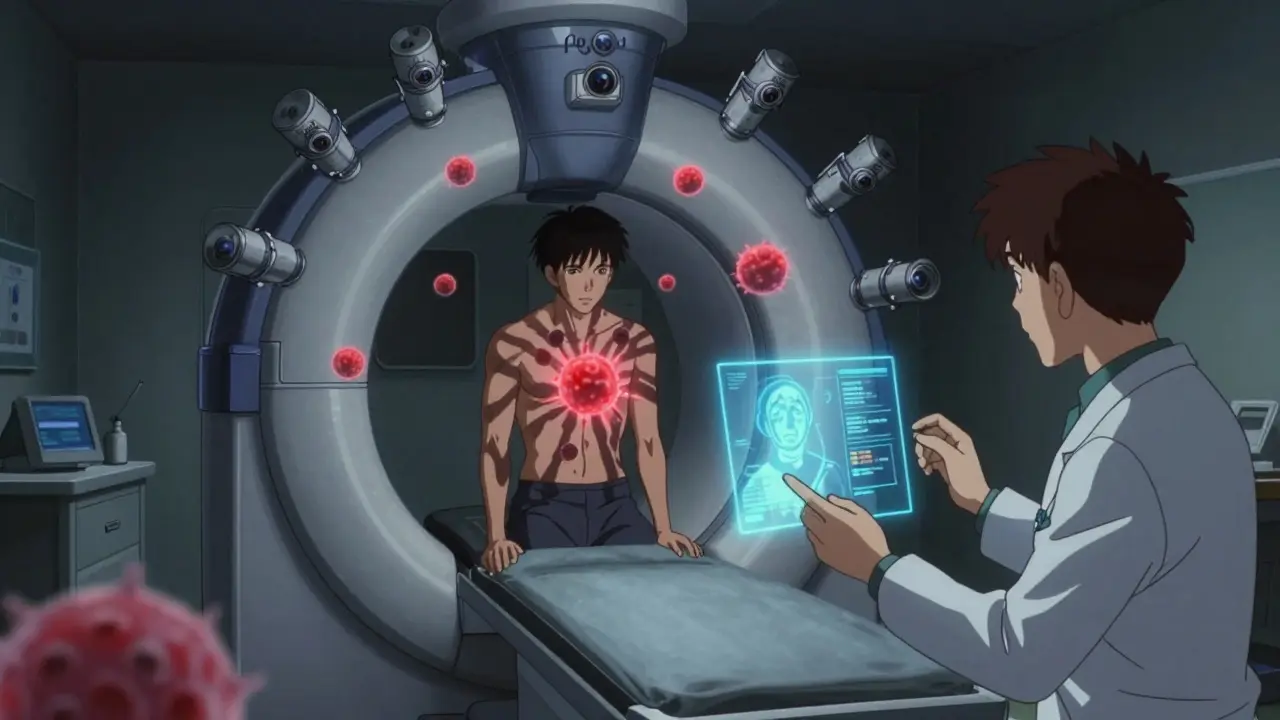
If melanoma spreads, surgery alone won’t cut it. That’s where immunotherapy changed everything.
Before 2011, metastatic melanoma meant months to live. Now, thanks to drugs like ipilimumab and pembrolizumab, some patients live for years. These drugs don’t attack the cancer directly. They take the brakes off your immune system. Melanoma hides from your T-cells by activating checkpoint proteins like PD-1 and CTLA-4. These drugs block those proteins, letting your immune system see and kill the cancer.
Combination therapy - using both anti-PD-1 and anti-CTLA-4 drugs - is now first-line for advanced cases. In clinical trials, over half of patients saw their tumors shrink. A third had complete responses - meaning scans showed no trace of cancer.
Newer drugs are coming. Regeneron’s fianlimab, paired with a PD-1 blocker, is in Phase 3 trials. It targets LAG-3, another immune checkpoint. Early results show even deeper responses than current combos.
Then there’s IMA203 PRAME cell therapy - a personalized treatment being tested in the SUPRAME trial. It takes your immune cells, trains them to recognize a protein called PRAME that melanoma cells carry, and sends them back into your body. In Phase 1b, 56% of patients had complete responses. That’s not a typo. Half the people treated had no detectable cancer left.
These treatments aren’t perfect. Side effects include fatigue, rashes, colitis, and in rare cases, autoimmune damage to the thyroid, liver, or lungs. But for many, the trade-off is worth it. One patient from Leeds told me, “I had four tumors. Now, they’re gone. I’m back hiking with my kids. I didn’t think that was possible.”
Real-world adoption is uneven. In the U.S., 68% of dermatology practices now use at least one AI tool. Mayo Clinic rolled it out across 22 locations in 2025. Cleveland Clinic cut unnecessary biopsies by 28% after adding DermaSensor. But small practices? They’re still using old methods.
Training is a barrier. DermaSensor needs 2-3 hours. Full AI platforms? 40+ hours. Many clinics don’t have the time or budget. Plus, integrating these tools with electronic health records is messy. One doctor said, “The AI gives me a report. I have to copy-paste it into our system. It’s like using a fax machine in 2026.”
Regulation is catching up. The FDA cleared 17 AI melanoma tools by 2025, up from just 3 in 2022. The EU has 42 CE-marked devices. But approval doesn’t mean access. Insurance coverage lags. Google Health’s DermAssist got 92% accuracy - but pulled out of the market in late 2024 because insurers wouldn’t pay for it.
You don’t need a scanner or a patch to save your life. Here’s what works now:
And if you’re diagnosed? Ask about immunotherapy. Ask about clinical trials. Don’t assume it’s too late. Even stage 4 melanoma isn’t a death sentence anymore.
By 2030, AI-assisted detection could be standard. Personalized immunotherapies might become routine. Wearable patches could monitor your skin while you sleep. But progress isn’t linear. Bias in data, cost barriers, and overdiagnosis risks are real.
The best outcome? Catching melanoma early - when it’s still just a mole - and treating it with a drug that lets your body do the work. That’s the new normal. And it’s working.
Yes - if caught early, melanoma has a 99%+ survival rate. Regular skin checks, knowing the ABCDE signs, and using dermoscopy or AI tools when available can catch it before it spreads. Most melanomas grow slowly, giving you time to act - if you’re looking.
For advanced melanoma, yes. Chemotherapy kills fast-growing cells but harms healthy ones too, with limited success. Immunotherapy trains your immune system to target cancer specifically. It’s more effective, often longer-lasting, and has fewer side effects for many patients. Some people stay in remission for years.
They’re highly accurate in research settings - some hit 99% sensitivity. But real-world use is trickier. AI struggles with diverse skin tones, poor lighting, or unusual mole shapes. They’re best used alongside a doctor’s exam, not instead of one. Always confirm AI results with a biopsy if needed.
Overdiagnosis. Some tools flag harmless moles as cancerous, leading to unnecessary biopsies, surgeries, and anxiety. Low-specificity devices like DermaSensor can cause more harm than good if used without proper follow-up. The goal isn’t to remove every mole - it’s to find the ones that will kill you.
No - not reliably. Many apps claim to detect melanoma, but none are FDA-approved for diagnosis. They often misclassify benign moles as cancerous or miss real melanomas. Apps can raise awareness, but they’re no substitute for a professional skin exam or dermoscopy.
You’re at higher risk if you have: more than 50 moles, a family history of melanoma, fair skin that burns easily, red or blond hair, a history of severe sunburns, or a weakened immune system. If you’ve had one melanoma, your risk of another is higher. Talk to your doctor about screening frequency.

Early detection saves lives. Period. If you see a mole changing, don’t wait. Get it checked. It’s that simple.

AI tools? Sure, they’re fancy-but let’s be real: most of these systems were trained on white skin. So when a Black guy gets a clean bill of health from an app, he’s not getting a second chance-he’s getting a death sentence. And nobody’s talking about it. We need equity in diagnostics, not just innovation.
It’s not just about accuracy-it’s about justice. If your algorithm can’t see melanoma on dark skin, it’s not smart-it’s racist.
And don’t get me started on insurance companies refusing to pay for FDA-approved tools because they’re ‘too expensive.’ We’re talking about skin cancer here. Not a luxury spa treatment.
Why are we still letting profit dictate who lives and who dies? We’ve got the tech. We’ve got the data. We’ve got the science. But we don’t have the will. And that’s the real cancer.
I’ve seen patients die because their GP didn’t have a dermatoscope. I’ve seen others get biopsied for harmless moles because a machine flagged them. We’re stuck in a loop of under-treatment and over-treatment-and the people paying the price are the ones who can’t afford to be wrong.
It’s not about tech. It’s about access. It’s about training. It’s about trust. And until we fix those, we’re just rearranging deck chairs on the Titanic.
Stop glorifying gadgets. Start fixing systems.

DermaSensor has a 26-40% specificity? That’s a disaster. You’re sending half your patients for unnecessary biopsies just to catch a few real cases. That’s not medicine-that’s triage by panic. And now doctors are burned out from false alarms. Great job, innovation.
And don’t even get me started on the ‘wearable patch’ nonsense. You want to stick something on your skin and wait for a report? That’s not science. That’s sci-fi fanfiction. We’re not in the future yet. We’re still struggling to get basic dermoscopy into rural clinics.
Everyone’s chasing the shiny object while the foundation crumbles. Fix the basics before you build a skyscraper on sand.

Immunotherapy isn’t a miracle. It’s a gamble with your immune system. People think ‘complete response’ means cured. It doesn’t. It means the cancer’s hiding. And when it comes back-and it often does-you’re out of options. The drugs are expensive, toxic, and unpredictable. And they work for maybe 30% of people.
Meanwhile, the pharmaceutical companies are raking in billions while patients suffer colitis, liver damage, and autoimmune collapse. They call it ‘life-saving.’ I call it corporate exploitation dressed in white coats.
And don’t tell me about ‘personalized cell therapy.’ That’s a $500,000 treatment for a handful of people. Who’s paying? Who’s eligible? Who gets left behind? This isn’t progress. It’s a luxury service for the privileged.
Yes, people live longer. But at what cost? And who’s really winning here? Not the patient. Not the system. Just the shareholders.
We need prevention. We need equity. We need public health. Not billionaire-funded biotech fantasies.
Stop calling this medicine. Call it capitalism with a stethoscope.

There’s something beautiful about immunotherapy-your own body fighting for you. It’s not poison. It’s awakening. And that’s powerful.
I know someone who had stage 4 melanoma. Four tumors. Now? Zero. He’s hiking with his kids. That’s not a statistic. That’s a miracle.
Yeah, side effects suck. But so does watching someone fade away. Sometimes, you take the risk. And if you do, you might get your life back.
It’s not perfect. But it’s hope. And hope matters.

AI isn’t detecting melanoma. It’s being used to push you into biopsies so hospitals can bill insurance. The FDA clears these tools because Big Pharma owns them. You think they care about your skin? They care about your co-pay.
And those ‘full-body scanners’? They’re just fancy cameras. The real secret? They’re collecting your biometric data. Every mole. Every freckle. Every scar. Who owns that? Who’s selling it? You think your skin data isn’t being sold to advertisers? Think again.
And don’t forget: the WHO has been warning about skin cancer surveillance as a gateway to mass biometric tracking. This isn’t medicine. It’s surveillance capitalism with a dermatoscope.
They’re normalizing constant monitoring. Soon, your smartwatch will beep: ‘Warning: suspicious pigmentation detected. Schedule biopsy. Pay $800.’
They’re not saving lives. They’re creating a new industry. And you’re the product.
Check your skin. Yes. But don’t trust the machines. They’re not your friends. They’re your landlords.
And if you’re using a phone app? You’re already compromised. Delete it. Now.

My aunt in Mumbai got diagnosed because she noticed a dark streak under her nail. No sunburn. No family history. Just a quiet change. She lived because she paid attention. No AI. No scanner. Just her eyes and a doctor who listened.
Technology is beautiful-but it forgets the human touch. A glance. A question. A moment of silence before saying, ‘Let’s look closer.’ That’s what saves lives.
Don’t let gadgets make you lazy. Stay curious. Stay watchful. Your skin remembers everything. So should you.

While immunotherapy represents a monumental advancement, its accessibility remains severely constrained in low-resource settings. The cost of pembrolizumab exceeds $150,000 annually in the U.S., and even in India, where generic versions exist, distribution networks are inadequate. Without systemic policy reform, these breakthroughs remain exclusive to the affluent.
Furthermore, AI-driven diagnostics, despite high accuracy in controlled trials, exhibit significant performance degradation when applied to diverse skin phenotypes. This technological bias perpetuates health inequities, particularly in regions with high melanoma incidence among darker-skinned populations, such as parts of South Asia and Sub-Saharan Africa.
It is imperative that regulatory bodies mandate diversity in training datasets and subsidize deployment in underserved clinics. Innovation without inclusion is not progress-it is exclusion disguised as advancement.

I love that we’re talking about this. I used to think melanoma was just a ‘sunburn thing.’ Then my cousin got diagnosed at 29. No history. No beach trips. Just a weird spot on her back. She’s fine now, thanks to early detection.
But I also think we’re missing the emotional side. People are scared to check their skin. They don’t want to find something bad. But not looking? That’s the real danger.
Maybe we need more stories like this. Not just data. Not just apps. Real people saying, ‘I looked. I acted. I lived.’
And yeah, the tech is cool-but don’t forget to look in the mirror. Sometimes, the best tool is just you.

My dad’s a mechanic. He’s got 60 moles. He doesn’t care about AI. He doesn’t even own a mirror for his back. So I bought him a $10 dermatoscope from Amazon and showed him how to use it. Now he checks himself every month. Took 10 minutes.
That’s the real win. Not the $200,000 scanner. Not the fancy patch. Just someone showing up for themselves-and someone else showing up for them.
Health tech doesn’t have to be expensive to be life-changing.
Also, sunscreen isn’t just for summer. I put it on my face every morning. Even when it’s cloudy. Even in December. My skin’s never been better.
Small things. Daily habits. That’s how you beat this.

One thing I’ve learned from working in rural clinics: the biggest barrier isn’t tech. It’s time. Doctors are stretched thin. A 10-minute skin check? That’s a luxury. So patients get rushed. Moles get ignored. And that’s where the tragedy happens.
We need nurse-led screenings. We need community health workers trained to spot ABCDE. We need mobile units. Not just AI. Not just scanners. Just people who care enough to look.
Technology helps. But compassion? That’s what saves lives.

Look, I’ve been to clinics in Cape Town where they don’t even have gloves. And you’re talking about AI scanners that cost $50,000? That’s not progress. That’s colonialism with a USB port.
You think a Black woman in Johannesburg is going to get a full-body scan? She’s lucky if she gets a doctor who doesn’t tell her it’s ‘just a rash.’
Stop pretending this is about science. It’s about power. Who gets seen. Who gets saved. Who gets ignored.
And don’t even get me started on the ‘wearable patch.’ You think someone who can’t afford soap is going to wear a $300 gadget? Please.
Fix the system. Not the sensor.

Immunotherapy’s mechanism is fascinating-it’s essentially a reactivation of endogenous immune surveillance by blocking inhibitory checkpoints like PD-1 and CTLA-4, thereby reversing T-cell anergy. The clinical response correlates with tumor mutational burden, which is why melanoma, with its UV-induced hypermutation, responds so dramatically.
But the real frontier is neoantigen-targeted therapies. PRAME, as mentioned, is a cancer-testis antigen expressed in 70% of melanomas but not in most somatic tissues-making it an ideal target. IMA203’s success in Phase 1b suggests TCR-engineered T-cell therapy may soon outperform checkpoint inhibitors in durability.
However, the issue of immune-related adverse events (irAEs) remains non-trivial; colitis, hypophysitis, and pneumonitis require prompt corticosteroid intervention. We need biomarkers to predict toxicity-maybe even machine learning models trained on cytokine profiles.
And the AI bias problem? It’s not just a dataset issue. It’s a fundamental flaw in how we define ‘normal’ skin. Most training sets use Fitzpatrick I–III phenotypes. We need to redefine ‘normal’ to include Fitzpatrick IV–VI. Otherwise, we’re engineering blindness.
Also, overdiagnosis is real. The incidence of melanoma has tripled since 1980, but mortality has barely budged. Are we treating more, or just detecting more indolent lesions? The answer lies in longitudinal studies of low-risk lesions-something we’re woefully underfunding.

My brother got diagnosed with melanoma after he ignored a spot on his scalp for two years. He thought it was dandruff. Turns out, it was Stage 2. He’s fine now, but it scared the hell out of us.
Just check your damn skin. Every month. Use a mirror. Look everywhere. Even places you don’t think about.
And if you’re not sure? Go see someone. Don’t wait. Don’t Google it. Don’t hope it goes away.
It’s not complicated. It’s just important.
Well said. Sometimes the simplest advice is the most powerful.