
Enter patient details to calculate Creatinine Clearance and view recommended DOAC dosing.
Prescribing blood thinners to patients with kidney problems is one of the trickiest balancing acts in modern medicine. You need enough drug to prevent a stroke, but not so much that you cause a life-threatening bleed. Direct Oral Anticoagulants (DOACs) have largely replaced warfarin because they are easier to use and generally safer. But when kidneys fail, these drugs can build up in the body, turning a protective medication into a dangerous liability.
If you are managing atrial fibrillation or deep vein thrombosis in patients with chronic kidney disease (CKD), getting the dose right isn't just about following a label-it's about understanding how each specific drug behaves in the bloodstream. A small error in calculation can lead to major complications. This guide breaks down exactly how to adjust doses for the four main DOACs, why the math matters more than you think, and which drugs are safest for the most vulnerable patients.
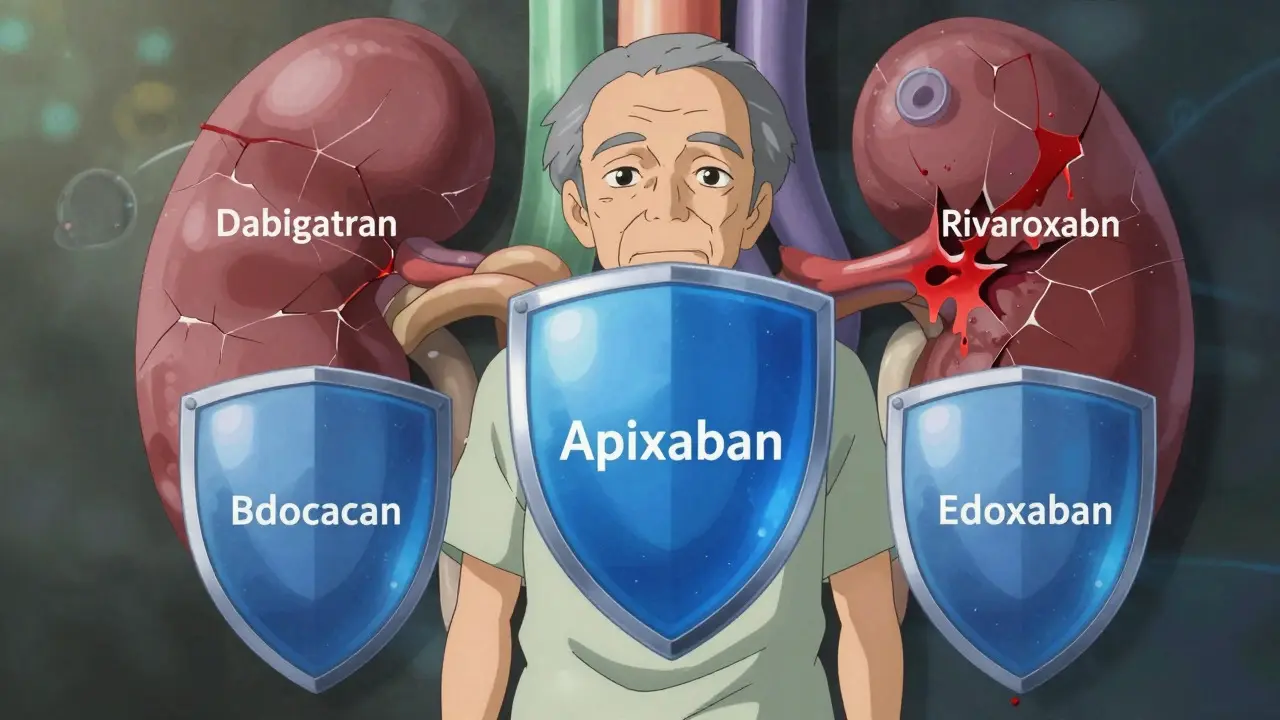
To understand the dosing rules, you first need to understand what these drugs actually do. Direct Oral Anticoagulants (DOACs) are a class of medications that inhibit specific clotting factors in the blood without requiring routine monitoring like INR checks. The four main players approved for stroke prevention in atrial fibrillation are apixaban, rivaroxaban, dabigatran, and edoxaban.
Unlike warfarin, which affects multiple clotting factors and requires constant testing, DOACs target single points in the coagulation cascade. This makes them predictable-but only if your body clears them as expected. Here is the catch: all four of these drugs rely on the kidneys to some degree for elimination.
When kidney function drops, these drugs stay in the system longer. If you keep the standard dose, the patient effectively takes a higher dose every day, increasing the risk of gastrointestinal bleeding or intracranial hemorrhage. If you cut the dose too aggressively, you leave them unprotected against clots. The goal is finding that narrow therapeutic window.
This is the single biggest source of prescribing errors. Most electronic health records display estimated Glomerular Filtration Rate (eGFR) automatically. It is tempting to look at that number and decide on a dose. Do not do it.
FDA labeling for DOACs specifically mandates the use of Creatinine Clearance (CrCl) calculated using the Cockcroft-Gault equation. The Cockcroft-Gault formula was developed in 1976 and remains the gold standard for drug dosing adjustments because it accounts for body weight, age, and serum creatinine in a way that correlates better with drug clearance than eGFR does.
Why the difference? eGFR is normalized to a standard body surface area (1.73 m²). For a very large person, eGFR might underestimate their actual kidney function. For a frail, elderly person with low muscle mass, eGFR might overestimate it. Since DOAC dosing depends on how much drug the kidneys can physically filter out per minute, CrCl gives you a more accurate picture of the patient's ability to clear the medication.
In practice, this means you often have to calculate CrCl manually or use a specific calculator within your pharmacy software. A 2022 study in the American Journal of Health-System Pharmacy found that nearly 30% of CrCl calculations in patients over 80 required manual adjustment due to discrepancies between automated eGFR values and true physiological clearance. Always double-check the math.
Each drug has its own set of rules. Memorizing them is essential for safe practice. Here is how the adjustments break down based on Creatinine Clearance (CrCl).
| Drug | Standard Dose | Renal Adjustment Criteria | Reduced Dose | Contraindicated Below |
|---|---|---|---|---|
| Apixaban | 5 mg twice daily | Need at least TWO of: 1. Age ≥80 years 2. Weight ≤60 kg 3. Serum Creatinine ≥1.5 mg/dL |
2.5 mg twice daily | CrCl <15 mL/min (unless on dialysis, see note below) |
| Rivaroxaban | 20 mg once daily (with food) | CrCl 15-50 mL/min | 15 mg once daily | CrCl <15 mL/min |
| Dabigatran | 150 mg twice daily | CrCl 15-30 mL/min | 75 mg twice daily | CrCl <15 mL/min |
| Edoxaban | 60 mg once daily | CrCl 15-50 mL/min OR weight ≤60 kg | 30 mg once daily | CrCl <15 mL/min |
Note on Apixaban: It is unique among the DOACs. The FDA label allows its use in End-Stage Renal Disease (ESRD) and hemodialysis patients, though clinical guidelines vary. Many experts prefer the reduced dose of 2.5 mg twice daily for these high-risk groups, even if they don't meet all three criteria, to minimize bleeding risk.

Among clinicians treating patients with moderate to severe kidney disease, Apixaban is frequently the preferred choice. Why? Because of its pharmacokinetic profile. Since only about a quarter of the drug is cleared by the kidneys, it accumulates less dramatically when renal function declines compared to dabigatran or rivaroxaban.
Data supports this preference. A review published in the Journal of the American Heart Association (2020) analyzed outcomes in patients with AF and advanced CKD or ESRD. They found that apixaban was associated with a lower risk of major bleeding compared to warfarin, and similar or better efficacy in preventing strokes. In contrast, rivaroxaban is generally not recommended for stage 5 CKD or dialysis patients according to major consensus documents.
However, "preferred" doesn't mean "risk-free." Dr. Michael Chen reported a case of life-threatening GI bleeding in a 78-year-old ESRD patient who was on the standard 5 mg dose of apixaban. The patient met two criteria for dose reduction (age and creatinine levels) but had been prescribed the full dose. This highlights that even with the "safest" DOAC, strict adherence to dosing criteria is non-negotiable.
You might wonder why we still talk about warfarin. For patients on hemodialysis (CrCl <15 mL/min), the evidence for any DOAC is still considered limited by some regulatory bodies. The 2018 ACC/AHA/HRS guidelines acknowledge both warfarin and apixaban for ESRD patients, but the data is sparse.
The AXIOS trial, which aimed to compare apixaban versus warfarin in hemodialysis patients, was terminated early due to poor enrollment. While preliminary data suggested potential benefits for apixaban, we lack the large-scale randomized controlled trials needed to definitively say one is superior in this specific population. As a result, many nephrologists still default to warfarin for dialysis patients, despite its higher risk of intracranial hemorrhage and the burden of INR monitoring.
However, trends are shifting. By 2026, projections suggest that 15-20% of ESRD patients with atrial fibrillation will be receiving DOACs, up from roughly 10% in 2023. As more real-world data emerges, apixaban is likely to become the standard of care even in dialysis units, provided doses are carefully managed.
How do you implement this safely in a busy clinic or hospital setting? Here is a checklist to protect your patients:
The landscape is evolving rapidly. The global DOAC market is growing, driven by the aging population and rising rates of atrial fibrillation. But the focus is shifting toward precision medicine.
We are waiting for results from trials like RENAL-AF, which compares apixaban to dose-adjusted warfarin in severe renal impairment. Results are expected in 2025. These studies aim to provide the definitive evidence needed to update guidelines for the most fragile patients. Until then, the rule remains: know your patient's kidneys, calculate your clearance accurately, and choose the drug with the lowest renal dependence when in doubt.
No. FDA labeling for all major DOACs specifically requires the use of Creatinine Clearance (CrCl) calculated via the Cockcroft-Gault formula. eGFR is normalized to body surface area and can significantly misrepresent drug clearance in elderly, obese, or underweight patients, leading to overdosing or underdosing.
Apixaban is currently considered the safest option for patients with End-Stage Renal Disease (ESRD) and those on hemodialysis. It has the lowest percentage of renal elimination (approx. 27%) and has shown favorable bleeding profiles compared to warfarin in observational studies. However, evidence is still emerging, and clinical judgment is essential.
You must reduce apixaban from 5 mg to 2.5 mg twice daily if the patient meets at least two of the following three criteria: Age 80 years or older, body weight 60 kg or less, or serum creatinine 1.5 mg/dL (133 μmol/L) or higher. This applies regardless of the exact CrCl value, although it is contraindicated if CrCl is below 15 mL/min unless specific clinical conditions apply.
Dabigatran is highly dependent on renal clearance (about 80%). It is generally safe for patients with mild impairment (CrCl >30 mL/min) at standard doses. However, for CrCl between 15-30 mL/min, the dose must be reduced to 75 mg twice daily. It is contraindicated if CrCl is below 15 mL/min.
At minimum, check serum creatinine and recalculate CrCl annually. However, in patients with known CKD, heart failure, or those taking nephrotoxic drugs, more frequent monitoring (every 3-6 months) is recommended. Always re-evaluate dosing if the patient experiences acute illness, dehydration, or hospitalization.