When you’ve been living with chronic pain for months-or years-every pill, every doctor’s visit, every new treatment feels like a gamble. You’ve tried painkillers. You’ve dealt with side effects. Maybe you’ve even come close to opioids. And now you’re hearing about acupuncture: needles inserted into your skin, supposedly to ease pain. Is it real? Or just ancient superstition dressed up as medicine?
The short answer: acupuncture for pain works. Not because of magic, but because science now shows it changes how your body processes pain. It’s not a miracle cure. But for millions of people with chronic back pain, arthritis, or tension headaches, it’s a legitimate, low-risk tool that’s backed by data, not just tradition.
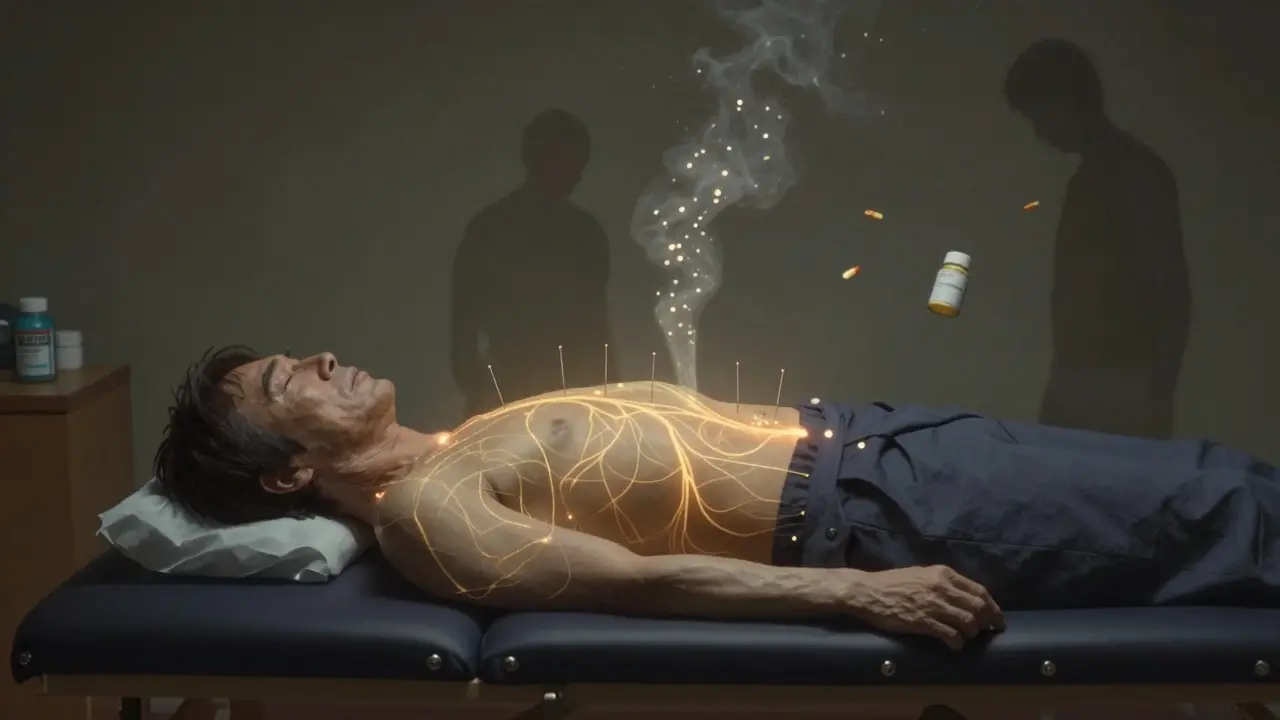
Traditional Chinese medicine talks about energy flow-qi-moving through invisible channels called meridians. Needles are placed along these lines to unblock stagnation. But modern research doesn’t rely on energy. It looks at nerves, chemicals, and brain activity.
When a thin needle is inserted into specific points on the skin, it triggers a cascade of biological responses:
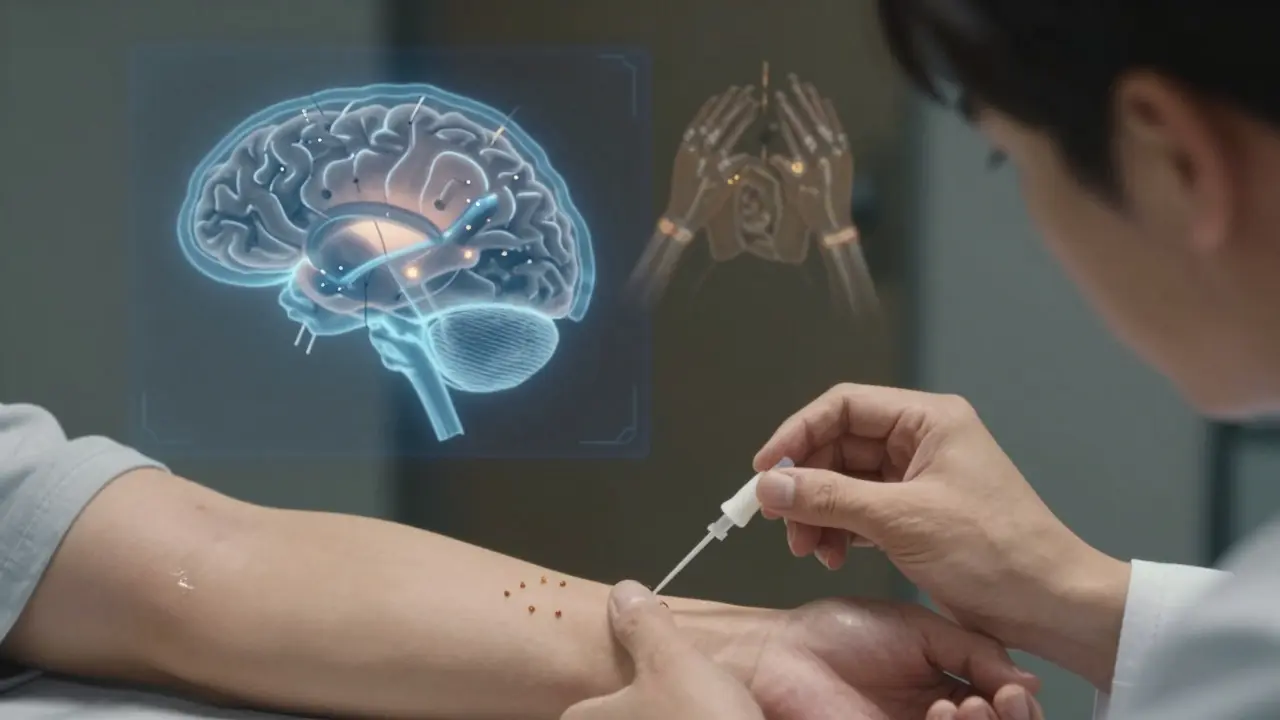
This isn’t guesswork. Brain scans from studies at Harvard, UCLA, and the National Institutes of Health show clear changes in pain-processing areas after acupuncture. It doesn’t just distract you from pain-it literally rewires how your brain perceives it.
In 2018, researchers analyzed data from nearly 21,000 patients across 39 high-quality clinical trials. The result? Acupuncture provided clinically meaningful pain relief compared to no treatment at all-and those effects lasted at least a year after treatment ended. That’s not a fluke. That’s a pattern.
Here’s what the data shows for specific conditions:
But what about placebo? That’s the big question. Critics say: maybe it’s just the ritual. Maybe it’s the attention from a caring practitioner.
Here’s the twist: even when compared to sham acupuncture-where needles barely touch the skin or are inserted at non-acupuncture points-real acupuncture still performed better. The difference isn’t huge, but it’s consistent. In a 2012 meta-analysis of nearly 18,000 patients, real acupuncture showed a 0.23 standard deviation advantage over sham for back pain. That’s small, but statistically meaningful. And in real life, that’s enough to mean fewer pills, better sleep, and less disability.
Most people don’t choose acupuncture because they hate medicine. They choose it because they’ve had enough of side effects.
NSAIDs like ibuprofen and naproxen cause an estimated 103,000 hospitalizations every year in the U.S. due to stomach ulcers and bleeding. Opioids? They’re addictive. In 2022 alone, 47,000 Americans died from opioid overdoses.
Acupuncture? Serious side effects are extremely rare. A 2017 review of over 22,000 treatments found serious adverse events in less than 0.05% of cases. That’s safer than aspirin.
And here’s the kicker: acupuncture can reduce opioid use. A 2022 review of 22 systematic reviews found that patients who got acupuncture after surgery needed fewer opioids-and had less nausea and drowsiness as a result. That’s not just pain relief. That’s harm reduction.
Not all pain is the same. Acupuncture isn’t a magic wand. But it’s incredibly effective for certain types:
It’s less effective for acute pain-like a sprained ankle or post-surgical pain right after the operation. In those cases, drugs still win. But for pain that sticks around? Acupuncture holds its own.
It’s not what you see in movies. No dramatic flailing. No burning incense. Just quiet, calm, and precise.
A session usually lasts 20-30 minutes. You lie on a table. The practitioner inserts very thin, sterile, single-use needles-about as thick as a human hair-at specific points. You might feel a slight pinch, then nothing. Or a dull ache, warmth, or tingling. That’s normal.
Most people get 6 to 12 sessions over 6 to 8 weeks. That’s the sweet spot, according to the largest trials. After that, maintenance sessions every 4 to 8 weeks help keep results going.
Practitioners use one of three approaches:
Some practitioners add mild electrical stimulation to the needles. That’s called electroacupuncture. It’s common in research studies and may boost results for certain types of pain.
Cost is a real barrier. A single session runs $60 to $120. Insurance? Only about 56% of private plans in the U.S. cover it for pain as of 2022. Medicare started covering acupuncture for chronic low back pain in 2020-about 12.5 million beneficiaries now have access.
But here’s the upside: acupuncture can save money long-term. A 2021 study found that for chronic low back pain, acupuncture saved $1,873 per patient over a year compared to usual care. That’s because fewer doctor visits, fewer pills, fewer ER trips.
To find a good practitioner:
Reddit threads from r/acupuncture show 78% positive sentiment. Common praises: “No more ibuprofen,” “I sleep through the night,” “I can walk without limping.” Complaints? High cost and inconsistent results from different practitioners.
Some experts still argue the effects are mostly placebo. Dr. Edzard Ernst, a former professor of complementary medicine, said the tiny difference between real and sham acupuncture suggests non-specific effects dominate.
But here’s the problem with that view: placebo doesn’t last 12 months. Placebo doesn’t reduce brain activity in pain centers on fMRI scans. Placebo doesn’t cut opioid use in post-op patients.
The American Academy of Family Physicians put it plainly in 2018: “The effects of acupuncture persist over time, and the benefits cannot be explained away solely by the placebo effect.”
And if you’ve lived with pain for years, does it really matter if it’s “placebo” if it gets you off opioids and back to your life?
Acupuncture is no longer fringe. It’s being adopted by mainstream systems:
It’s not replacing medicine. It’s becoming part of it. The CDC’s 2022 guidelines recommend multimodal pain care-physical therapy, exercise, psychological support, and acupuncture. No single solution works for everyone. But acupuncture? It’s one of the few tools that’s effective, safe, and backed by solid science.
If you’ve tried everything else and still hurt-yes.
You don’t need to believe in energy channels. You don’t need to love needles. You just need to want to feel better.
Acupuncture isn’t a cure-all. But for chronic pain? It’s one of the most reliable, low-risk options we have. And in a world drowning in pills and side effects, that’s not just helpful. It’s revolutionary.
Most people feel only a slight pinch when the needle goes in-less than a mosquito bite. After that, there’s usually no pain. Some feel warmth, heaviness, or tingling, which is normal. If you feel sharp pain, tell your practitioner. They’ll adjust it.
Most people notice improvement by session 6. The standard course is 6 to 12 sessions over 6 to 8 weeks. Chronic conditions often need ongoing maintenance sessions every few weeks. Don’t expect miracles after one visit-it’s cumulative.
Extremely. Serious side effects are rare-less than 0.05% of treatments. All needles are sterile and single-use (FDA-regulated since 1996). The biggest risk is if the practitioner isn’t trained. Always choose someone certified by NCCAOM.
It can reduce your reliance on medication, especially NSAIDs and opioids. Many patients cut their pill use by 50-75%. But don’t stop meds cold turkey. Work with your doctor to taper safely while adding acupuncture as part of a broader plan.
It depends. Medicare covers it for chronic low back pain. About half of private insurers cover it for pain conditions, but often with limits-like 10 sessions per year. Always call your insurer and ask: "Do you cover acupuncture for [your condition]?"

I’ve been getting acupuncture for my lower back for about a year now, and honestly? It’s the only thing that’s let me sleep through the night without reaching for ibuprofen. I used to think it was all placebo too-until I started tracking my pain levels. The difference between sham and real? I could feel it. Not just in my back, but in how I moved, how I breathed, how I stopped dreading mornings. It’s not magic, but it’s science with a human touch. And yeah, it costs a bit, but compared to ER visits or opioid prescriptions? Worth every penny.

Stop selling snake oil. I’ve had 12 sessions and felt zero difference. The whole thing’s a money grab. People are desperate, and that’s why they fall for it. The ‘science’? Tiny effect sizes, biased studies, and cherry-picked trials. If it worked, why isn’t every hospital doing it? Because it doesn’t. Plain and simple.

Hey, I just wanted to say I’m really glad you wrote this. I’ve been dealing with chronic migraines for 8 years, and after my third acupuncture session, I didn’t have to take my triptan. Not once. I know people say it’s placebo, but I don’t care. What matters is I’m not curled up in a dark room anymore. I’m back to reading, cooking, laughing. That’s not placebo. That’s life. If this helps even one person get off pills, it’s worth it.

As someone from Australia where acupuncture is covered under Medicare for chronic pain, I can confirm it’s legit. My mum had knee OA and went from barely walking to hiking again after 10 sessions. No side effects, no dependency. The fact that the VA and NIH are investing in it? That says more than any Reddit thread. It’s not a cure, but it’s a tool-and we’re finally starting to treat pain like a whole-system issue, not just a symptom to crush with pills.

LOL at the ‘science’. 😂 You really believe brain scans = proof? That’s like saying holding a magnet to your head cures depression because the fMRI lights up. Also, ‘safer than aspirin’? Bro, aspirin kills 10k people a year. Acupuncture kills 0.05%? That’s like saying skydiving is safe because ‘only’ 0.01% of jumpers die. 😭

Y’all are overcomplicating this. Acupuncture doesn’t need a 50-page thesis to be valid. I had sciatica so bad I couldn’t tie my shoes. After two sessions? I walked to the mailbox without wincing. No magic, no energy, no BS-just a needle in my butt that made my leg stop screaming. I don’t care if it’s endorphins or vibes. It worked. And now I’m off the NSAIDs. That’s the win. Keep it simple, folks.

weird how the same people who roll their eyes at ‘energy channels’ will happily take a pill that’s been around for 70 years with zero idea how it works. ibuprofen? we still don’t fully understand its mechanism. but needles? oh no, that’s witchcraft. funny how science gets selective when it suits the narrative. 🤷♂️

It’s fascinating how deeply we resist anything that doesn’t fit into the biomedical model. We’ve been conditioned to equate ‘scientific’ with ‘pharmaceutical’-but science isn’t a product line. It’s a process. Acupuncture’s mechanisms may be complex, but they’re observable, measurable, and reproducible. The real question isn’t whether it works-it’s why we’re so uncomfortable admitting we don’t have all the answers.

As a physical therapist who has referred over 200 patients to licensed acupuncturists, I can say with clinical certainty that this intervention belongs in standard pain management protocols. The data is robust, the safety profile is exceptional, and patient-reported outcomes consistently outperform pharmacological alternatives for chronic, non-acute conditions. This is not alternative medicine. It is evidence-based, integrative care.

Look, I used to be skeptical too. Then I went to a guy in Portland who did electroacupuncture on my shoulder and I cried because it didn’t hurt anymore. I’ve done 14 sessions. I’ve saved $4,000 on meds. I’m sleeping 7 hours. I don’t need to know why it works. I just need it to work. And it does. Case closed. End of story. Don’t overthink it. Just try it.

ACUPUNCTURE IS A C.I.A. OPERATION TO MAKE PEOPLE DEPENDENT ON NEEDED THERAPIES SO THEY’LL STOP QUESTIONING THE SYSTEM. THEY’RE USING NEEDLES TO INSERT TRACKING CHIPS. THE ‘STERILE’ ONES? THEY’RE ALREADY INFECTED WITH NANOTECH. DON’T BELIEVE THE LIES. THE V.A. IS IN ON IT. THEY WANT YOU WEAK. 🕵️♀️🩸

When the body is in pain it is not a problem to be solved but a message to be heard. Modern medicine treats symptoms as enemies. Acupuncture invites us to listen. The needle is not a weapon but a whisper. The pain does not vanish because it is erased but because it is understood. This is not medicine. This is philosophy with needles.

Just had my 6th session and I swear I can feel the tension leaving my neck. No more headaches. No more caffeine just to function. I used to think this was woo but now I’m the one telling my coworkers to try it. I’m not even religious but I feel like I’ve been given a second chance. Thank you for writing this. Seriously.