
When you're pregnant, every decision feels bigger. Should you eat sushi? Is it safe to dye your hair? What about vaccines? The truth is, some vaccines aren't just safe during pregnancy-they're one of the best things you can do for your baby’s health. Yet, confusion still lingers. Many people worry about risks, timing, or whether the shots even work. The science is clear: getting the right vaccines while pregnant protects both you and your newborn in ways that post-birth shots simply can’t.

Why Vaccines During Pregnancy Matter

Your immune system changes during pregnancy. It doesn’t weaken-it adapts. But that adaptation makes you more vulnerable to serious infections like the flu, whooping cough, and COVID-19. These aren’t minor illnesses. Flu during pregnancy doubles your risk of preterm birth. Whooping cough can be deadly for newborns under two months old. And COVID-19 increases your chance of needing ICU care by 2.5 times compared to non-pregnant people of the same age.

The good news? Your body can pass protection to your baby. Antibodies from vaccines you get while pregnant cross the placenta. By the time your baby is born, they already have a shield against diseases they’re too young to be vaccinated against themselves. For example, babies born to mothers who got the Tdap vaccine between 27 and 36 weeks have antibody levels in their blood that are 1.4 times higher than their mother’s. That’s not luck-it’s biology working the way it should.

The Four Vaccines You Need During Pregnancy

Not all vaccines are safe during pregnancy. Live vaccines like MMR and varicella are off-limits because they contain weakened viruses. But the ones you do need are inactivated or mRNA-based, and they’ve been studied in millions of pregnancies.

  • Influenza (flu) vaccine: Recommended during any trimester, but ideally between September and October. The CDC found that flu shots during pregnancy reduce the risk of flu in babies under six months by 41-63%. The 2020-21 flu season saw over 264,000 pregnant people in England get the shot. Side effects? Mostly mild soreness at the injection site.
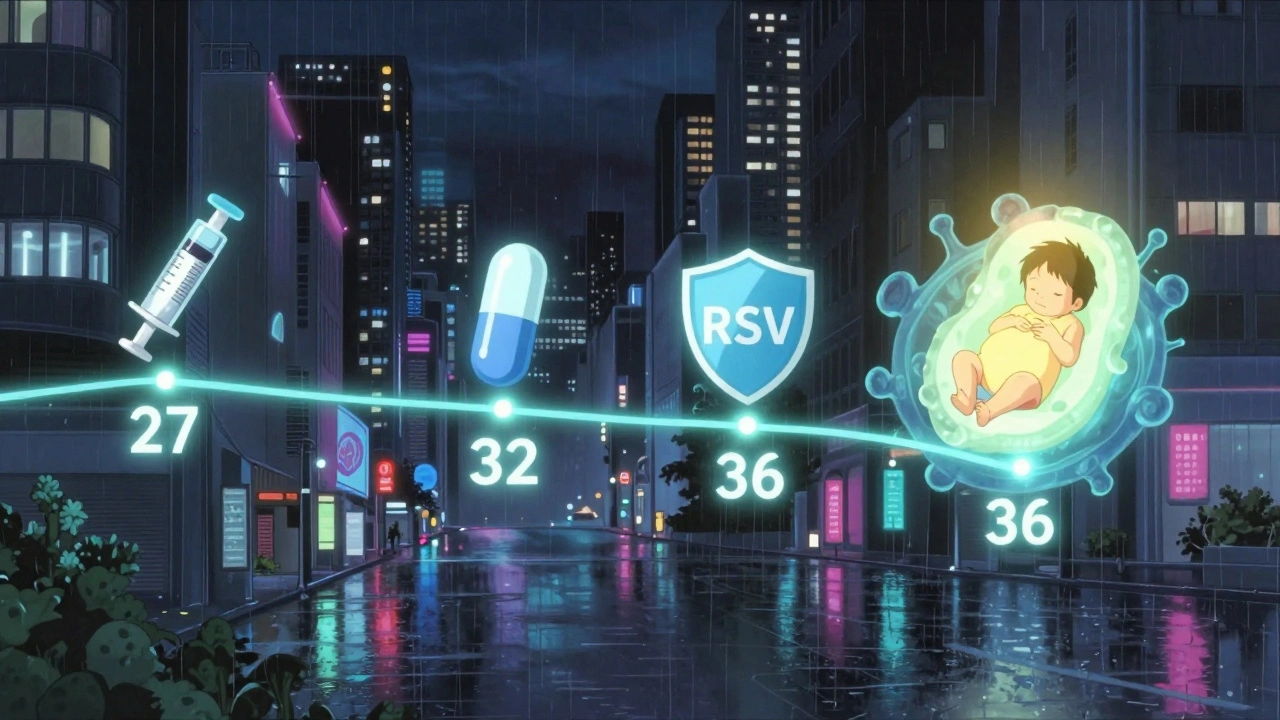
  • Tdap (tetanus, diphtheria, pertussis): Must be given between 27 and 36 weeks, with the sweet spot being 27-30 weeks. This timing gives your baby the highest possible antibody levels. If you get it too early-before 20 weeks-you lose nearly 37% of the protection. Every pregnancy needs its own dose, even if you got it last time. In 2021, 67.1% of pregnant people in England received it. That’s up from 14.4% in 2012.
  • COVID-19 mRNA vaccines (Pfizer-BioNTech or Moderna): Safe at any stage. Data from over 139,000 pregnant people in the CDC’s v-safe registry showed no increase in miscarriage, preterm birth, or birth defects. In fact, 96% of pregnant people hospitalized with severe COVID-19 in 2021 were unvaccinated. Updated monovalent boosters are now recommended as they become available.
  • RSV vaccine (Abrysvo): Approved in May 2023 and recommended between 32 and 36 weeks during September through January. It cuts the risk of severe RSV infection in newborns by 81.8% in the first 90 days of life. In a 2023 survey of 3,215 parents on BabyCenter, 92% reported no side effects after receiving it.

What About Breastfeeding?

You don’t have to wait until after delivery to get protection. All the vaccines listed above are safe while breastfeeding. In fact, if you didn’t get them during pregnancy, you can still get them right after birth. The flu shot, Tdap, and COVID-19 vaccines won’t affect your milk supply or harm your baby. Breastfeeding adds another layer of protection-some antibodies pass into your milk, giving your baby extra defense. But nothing replaces the placental transfer you get during pregnancy.

What Vaccines to Avoid

Avoid live vaccines entirely while pregnant. That includes:

  • MMR (measles, mumps, rubella)
  • Varicella (chickenpox)
  • Nasal spray flu vaccine (LAIV)
  • Yellow fever (unless travel to high-risk area and risk outweighs benefit)
  • Live attenuated zoster (shingles) vaccine
If you need any of these, get them at least 28 days before trying to conceive. The CDC updated this guidance in February 2022 after reviewing decades of safety data. There’s no evidence these vaccines cause birth defects-but the theoretical risk is enough to wait.

Mother breastfeeding as antibodies from pregnancy protect her newborn in a dreamlike scene.

Real-World Safety Data

Concerns about safety aren’t baseless. People remember stories from years ago. But today’s data is overwhelming. A 2023 review of 147 studies involving 2.3 million pregnancies concluded the benefits of recommended vaccines far outweigh any theoretical risks. The CDC’s Vaccine Safety Datalink tracked 39,055 pregnancies where mothers received Tdap. No safety signals emerged. The same goes for over 1.5 million pregnant people who got the flu shot between 2010 and 2022.

The FDA’s Pregnancy and Lactation Labeling Rule, introduced in 2015, now requires vaccine manufacturers to include detailed pregnancy data in their labeling. That means every shot you get has been studied in real human pregnancies-not just animals.

What Happens After You Get the Shot?

Side effects are usually mild. In the CDC’s v-safe registry, 69.8% of pregnant people reported injection site pain after the COVID-19 vaccine. Only 2.4% reported fever. Most symptoms last less than 48 hours. For Tdap, 68% of respondents on Reddit’s r/ObGyn described only mild arm soreness. The RSV vaccine had even fewer reports-only 8.7% mentioned headache or fatigue, and it lasted a day or two.

Serious reactions are extremely rare. The FDA reports 0.8 adverse event reports per 10,000 doses of Tdap and 1.2 per 10,000 for flu vaccines. That’s lower than the rate for many common medications. Every vaccine given in the U.S. is tracked through VAERS, and pregnancy-specific data is reviewed monthly.

Timing Matters-Here’s the Ideal Schedule

You don’t need to remember everything. But knowing the window for each shot helps you plan:

  1. Flu shot: As soon as it’s available (July-August). Get it by October if possible.
  2. Tdap: Between 27 and 36 weeks. Aim for 27-30 weeks.
  3. RSV vaccine: Between 32 and 36 weeks, during September-January.
  4. COVID-19 vaccine: Anytime. If you’re due for a booster, get it now-even if you’ve had it before.
If you’re late on Tdap? Get it anyway. Even at 37 weeks, you’re still giving your baby some protection. The same goes for the flu shot-get it in January if you missed October. Protection is better than none.

Timeline of pregnancy weeks with vaccine symbols glowing along a neon-lit path to a newborn.

What If You’re Not Sure?

Talk to your provider. But don’t wait for them to bring it up. A 2023 Health Affairs study found that when providers were required to document vaccination counseling in prenatal records, recommendation rates jumped from 76% to 94%. That means you might need to ask. Say: “Can we talk about which vaccines I should get this pregnancy?”

If you’re hesitant because of ingredients, ask for the vaccine fact sheet. The flu shot doesn’t contain live virus. The mRNA vaccines don’t alter your DNA. They’re just instructions for your cells to make a harmless piece of the virus so your immune system learns to fight it.

What’s Next?

The future of pregnancy vaccines is promising. A new Group B Streptococcus (GBS) vaccine, GBS6, is in Phase III trials as of September 2023. Early results show it boosts protective antibodies by 13 to 23 times. If approved, it could prevent one of the leading causes of newborn sepsis.

A universal flu vaccine is also in development. Current flu shots are 40-60% effective. The new mRNA-1010 candidate, entering Phase III in December 2023, aims for 85% effectiveness across multiple strains. That could mean fewer missed workdays, fewer hospitalizations, and better outcomes for babies.

Final Thoughts

Pregnancy vaccines aren’t optional extras. They’re essential care. They’re not just about avoiding illness-they’re about giving your baby the strongest possible start. The data is solid. The timing is clear. The safety record is better than most medications you take during pregnancy.

If you’re pregnant right now, check your calendar. Are you past 27 weeks? You still have time for Tdap and RSV. Is flu season here? Get the shot. Are you due for a COVID-19 booster? Don’t delay. Your baby’s first defense starts with you.

Can I get the flu shot during my first trimester?

Yes. The inactivated flu vaccine is safe during any trimester, including the first. The CDC recommends getting it as soon as it’s available, ideally by October, to ensure protection through the peak flu season. There’s no increased risk of miscarriage or birth defects linked to flu shots in pregnancy.

What if I got Tdap before I was pregnant?

You still need it during every pregnancy. Antibody levels drop over time, and the goal is to pass the highest possible amount to your baby right before birth. Even if you had Tdap five years ago, you’ll need another dose between 27 and 36 weeks of this pregnancy to protect your newborn.

Do vaccines cause autism in babies?

No. There is no scientific link between vaccines given during pregnancy and autism in children. This myth stems from discredited studies from the late 1990s that have been thoroughly debunked. Multiple large-scale studies involving over 1.5 million pregnant women and their children found no increased risk of autism from flu, Tdap, or COVID-19 vaccines.

Is the RSV vaccine really necessary?

Yes, especially if your baby will be born in fall or winter. RSV causes over 58,000 hospitalizations each year in children under five in the U.S. For infants under six months, it’s the leading cause of hospitalization. The RSV vaccine reduces severe infection by nearly 70% in the first six months of life. If your provider offers it between 32 and 36 weeks, take it.

Can I get all these vaccines at once?

Yes. The flu, Tdap, and COVID-19 vaccines can be given on the same day, in different arms. The RSV vaccine can also be given at the same visit if you’re in the right window. There’s no evidence that combining them reduces effectiveness or increases side effects. Many clinics offer them together to make it easier.

What if I miss the 27-36 week window for Tdap?

Get it as soon as possible-even after 36 weeks. While antibody transfer is highest when given at 27-30 weeks, you still pass some protection even later. If you deliver before getting it, you can receive Tdap right after birth, but your baby won’t get the same level of passive immunity. It’s better to get it during pregnancy.

Comments (3)

Adam Everitt
  • Adam Everitt
  • December 12, 2025 AT 23:25 PM

so like... vaccines n pregnancy? i mean i get the science but it still feels weird. like my body's not just mine anymore? idk. got the flu shot last year, arm hurt for a day. baby's fine. that's all i need.

Nathan Fatal
  • Nathan Fatal
  • December 14, 2025 AT 10:55 AM

The data is overwhelming. Over 2.3 million pregnancies reviewed across 147 studies. No credible safety signals for inactivated or mRNA vaccines. The placental transfer of antibodies is a biological imperative-not an experiment. If you're avoiding vaccines because of misinformation, you're not protecting your child-you're exposing them to preventable risks that have been quantified, measured, and debunked for decades.

Laura Weemering
  • Laura Weemering
  • December 14, 2025 AT 12:43 PM

I just... I can't stop thinking about thimerosal. I know it's been removed, but what if... what if they're lying? What if the 'studies' are funded by Big Pharma? I read a blog post once that said the CDC deletes negative data... and now I just... I don't know. I'm scared. I'm so scared.

Post-Comment