

Enter your medications and supplements to see potential interactions. This tool is for informational purposes only and does not replace professional medical advice.
Every year, millions of people in the U.S. take dietary supplements-vitamins, herbs, probiotics, fish oil, glucosamine-thinking they’re harmless because they’re "natural." But here’s the truth: supplements aren’t harmless. And if you’re not telling your doctor about them, you’re putting yourself at risk.
It’s not just about fish oil or vitamin D. People take St. John’s wort for depression, ginkgo for memory, garlic pills for blood pressure, and echinacea to avoid colds. These aren’t candy. They’re active substances that can interfere with your prescriptions, worsen chronic conditions, or even cause dangerous bleeding, heart problems, or liver damage. And most of the time, your doctor has no idea you’re taking them.
A 2019 study found only 33% of people who use supplements tell their doctors. That means two out of every three people are flying blind-taking something that could clash with their medication, and their provider doesn’t know. The FDA says this is the single biggest preventable safety issue in supplement use today. And it’s not because people are hiding things on purpose. It’s because no one asks, and no one thinks it matters.
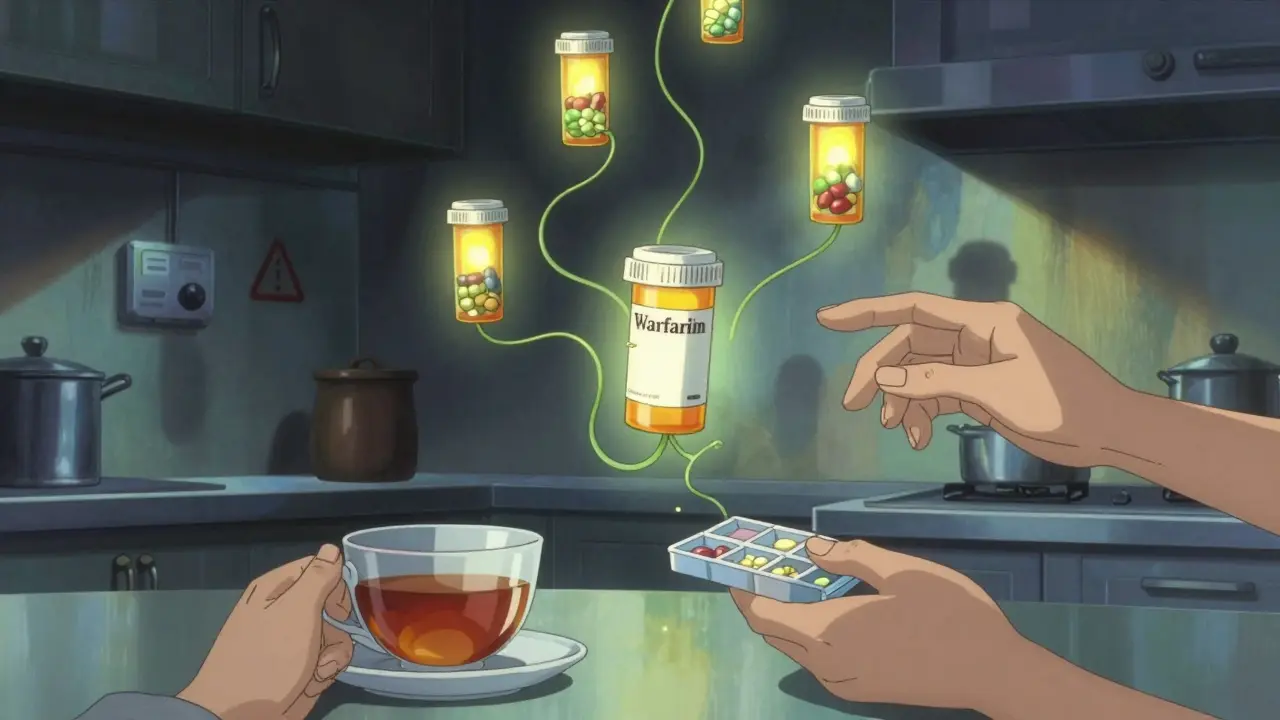
Let’s say you’re on warfarin, a blood thinner. You start taking ginkgo biloba because you read online it helps with brain fog. Ginkgo thins the blood too. Together, they can cause internal bleeding-something you might not notice until it’s too late. That’s not theory. It’s a documented case in the AMA Journal of Ethics, where a patient ended up in the ER after combining ginkgo with warfarin. The patient didn’t think their doctor needed to know about "natural" stuff.
Or take St. John’s wort. It’s popular for mood support. But it reduces the effectiveness of 57% of prescription drugs, including birth control pills, antidepressants, and even some cancer treatments. A viral TikTok video showed a woman who got pregnant while on birth control and taking St. John’s wort-because her doctor never asked.
Supplements aren’t regulated like drugs. The FDA doesn’t test them before they hit shelves. A 2015 study found 23,000 emergency room visits each year are linked to supplements. Many of those could’ve been avoided if providers knew what patients were taking.
The Dietary Supplement Health and Education Act (DSHEA) of 1994 lets companies sell supplements without proving they’re safe or effective. That’s not a loophole-it’s the law. Manufacturers only have to say their product isn’t contaminated or falsely labeled. No clinical trials. No proof it works. No pre-market approval.
Labels look official. They have a "Supplement Facts" panel. But here’s what they won’t tell you: the amount of active ingredient might be way off. A 2023 FDA database found some products had 20% less or 300% more than what’s listed. Some even contained hidden drugs-like erectile dysfunction pills or steroids-labeled as "natural energy boosters."
And the disclaimer on the bottle? "This statement has not been evaluated by the FDA. This product is not intended to diagnose, treat, cure, or prevent any disease." That’s not a warning. It’s a legal shield for the company. It doesn’t mean the product is safe. It just means they’re not claiming it is.
People with chronic conditions are the most at risk. Over half of supplement users have diabetes, high blood pressure, heart disease, or other long-term illnesses. Yet, disclosure rates among this group are only 51%. Why?
Many think their doctor won’t care. Or worse-they’ve been told before, "Don’t waste my time with that herbal stuff." One patient on Healthgrades wrote, "My doctor rolled his eyes when I mentioned turmeric. I stopped telling him after that."
Others assume supplements are too "natural" to matter. Or they’re embarrassed. Or they don’t know how to bring it up. A nurse practitioner in a Reddit thread shared her trick: "I ask, 'What supplements or vitamins are you taking that your pharmacist might not know about?'" That small shift in wording made disclosure rates double in her practice.
International data shows this isn’t inevitable. In the UK and Australia, disclosure rates are over 50%-because providers ask, consistently, and without judgment. In the U.S., it’s still a guessing game.
Here’s how to make this conversation normal, easy, and safe:
Don’t be afraid to ask your provider: "Do you know how this interacts with my other meds?" If they say, "I don’t know much about supplements," that’s your cue to bring in your own research-or ask for a referral to a pharmacist who specializes in interactions.
Doctors aren’t trained for this. Medical students get less than 3 hours of nutrition or supplement education in four years. That’s why the American Medical Association now recommends screening for supplement use at every visit.
Good providers:
Hospitals are starting to catch up. As of January 2023, 87% of American hospitals require supplement disclosure during admission. That’s progress. But it’s still not standard in outpatient clinics.

There’s movement. The FDA’s Dietary Supplement Ingredient Database (DSID-5), released in January 2023, gives providers verified ingredient amounts for 650 common supplements. That’s huge. No more guessing if that "1,000 mg" label is real.
Epic Systems, the biggest electronic health record platform, is adding a dedicated supplement module in mid-2024. It will flag dangerous interactions automatically. That means your doctor will see a red alert if you’re on blood thinners and taking ginkgo.
Legislation is also on the table. The Dietary Supplement Listing Act of 2022 would require companies to register every product with the FDA. Right now, only 1,200 new ingredients have been officially notified since 1994-despite 85,000 products on the market. That’s a massive gap.
But none of this matters if you don’t speak up.
Supplements aren’t the enemy. They can help. But they’re not risk-free. And the biggest risk isn’t the product-it’s the silence around it.
You wouldn’t hide that you’re taking blood pressure pills. So why hide the turmeric, the melatonin, the magnesium? They’re just as powerful. And they can be just as dangerous.
Next time you see your doctor, bring your supplement list. Write it down. Show it to them. Ask: "Could this interfere with anything I’m taking?" If they brush you off, find someone who won’t.
Because in medicine, the most dangerous thing isn’t what you take. It’s what you don’t say.
Yes. Even common ones like vitamin D, fish oil, or garlic pills can interact with medications. For example, fish oil can increase bleeding risk when taken with blood thinners. St. John’s wort can make birth control, antidepressants, and chemotherapy drugs less effective. Your doctor can’t protect you if they don’t know what you’re taking.
No. "Natural" doesn’t mean safe. Many dangerous substances come from plants-like poison ivy or deadly nightshade. Supplements aren’t tested for safety before sale. A 2022 FDA report found 16,917 emergency visits linked to supplements-up 32% since 2019. Prescription drugs go through years of testing. Supplements don’t.
That’s common. Most doctors get little training on supplements. But you can still share your list and ask: "Can you check this against my medications?" Many clinics now use tools like the Natural Medicine Database or have pharmacists on staff who specialize in interactions. You’re not asking them to be experts-you’re asking them to use available resources.
Absolutely. Many supplements-like ginkgo, garlic, ginger, and fish oil-can increase bleeding during and after surgery. Others, like kava or valerian, can interfere with anesthesia. Surgeons ask about supplements before operations, but if you don’t mention them, they won’t know. Always tell your surgical team at least two weeks before your procedure.
Look for third-party testing seals like USP, NSF, or ConsumerLab. These organizations test for purity, potency, and whether the label matches what’s inside. Avoid products that promise "miracle cures" or use terms like "clinically proven" without citing studies. The FDA doesn’t approve supplements, so certification from independent labs is your best protection.
No. Stopping suddenly could cause withdrawal symptoms or make your condition worse. Instead, bring your full list-even if you think it’s unimportant. Your doctor can help you decide what to keep, adjust, or stop, based on your health goals and current medications.

lol so now even my turmeric is a threat?? 😂 my grandma took 10 garlic pills a day and lived to 98. natural ain't poison unless you're a corporate lawyer with a lawsuit agenda.

YES. THIS. 🙌 I was on statins and started taking omega-3s because my buddy said it "cleans arteries." My doctor didn't ask - I didn't think it mattered. Then I got a nosebleed that wouldn't stop. Turned out the combo was thinning my blood like crazy. Now I bring a list. Every. Single. Visit. Don't be the guy who almost dies because he thought "natural" meant "safe."

The FDA is a joke. They regulate aspirin like it's plutonium but let companies sell "miracle weight loss gummies" laced with sibutramine. This article is correct but too polite. The real issue is capitalism selling snake oil to the gullible and doctors too lazy to care

You people think your western medicine is better than our herbs? In Nigeria we use moringa for diabetes and neem for blood pressure - no hospital needed. You swallow pills like robots and then blame the supplement. Your system is broken not the herbs

The DSHEA is a regulatory abomination. The FDA's post-market surveillance model for supplements is a classic case of institutional capture - industry-funded lobbying > public safety. The 23,000 ER visits? That’s not a statistic - it’s a systemic failure of risk governance. Until we reclassify supplements as pharmacologically active agents, we're just playing Russian roulette with our liver enzymes.

You're not alone. I used to hide my CBD gummies too. Then my mom had a stroke and the ER doc asked if she took anything weird. She said "no." Turned out she was taking ginkgo for memory. That stuff nearly killed her. Now I bring my whole damn cabinet to every appointment. It's not embarrassing - it's survival.

Nature doesn't care about your prescriptions. A tree doesn't know you're on warfarin. Ginkgo? It's just doing its job. The problem isn't the supplement - it's the illusion that we can control nature with a pill and a checklist. Maybe we should ask: why are we so afraid of our own bodies? 🌿

I read this whole thing and still don't get why people are so scared of supplements. I take 17 different ones. Ashwagandha, lion's mane, collagen, magnesium glycinate, NMN, resveratrol, curcumin, zinc, vitamin D3K2, omega-3, probiotics, creatine, berberine, spirulina, NAC, alpha-lipoic acid, and melatonin. My bloodwork is perfect. My energy is through the roof. My doctor said "keep doing whatever you're doing." So why are you all so anxious? Are you scared of being healthy? Or just scared of being told you're wrong?

Ah yes, the classic "natural is dangerous" narrative. Convenient for Big Pharma who makes billions off synthetic drugs that come with 17 side effects and a 30-page warning label. Meanwhile, turmeric has been used for 4,000 years without a single FDA-mandated recall. But sure - let’s trust the same agency that approved thalidomide and Vioxx. 🤡 The real danger isn’t the supplement - it’s the blind faith in broken institutions.

In Indonesia, we drink kencur (aromatic ginger) tea every morning for immunity. No one thinks twice. No one asks a doctor. We trust our ancestors, not a lab in Ohio. This article feels like cultural imperialism dressed as public health. Maybe the problem isn't the supplement - it's the arrogance of thinking your way is the only way.

If you're taking supplements, you're already ahead of 80% of people who just eat processed crap. Don't let fear silence your wellness journey. Just be smart. Write it down. Show your doc. Ask questions. You're not a guinea pig - you're an active participant in your health. And that? That’s powerful.

So let me get this straight - we're supposed to trust a system that lets companies sell "natural energy boosters" laced with sildenafil… but we can't trust a plant that's been used for centuries? The real conspiracy isn't the supplement industry. It's the medical-industrial complex that profits from your ignorance.

I used to skip telling my doctor about my fish oil. Then I got a weird bruise. Turned out it was fine. But now I just say it. It’s easier. Less stress. And honestly? Most docs don’t care as much as you think. They just want to know so they don’t accidentally kill you.