
Picture this: you’re staring at your computer screen, feeling a dull pressure tightening around your forehead. Is it just stress? Or is something neurological firing off signals that need specific attention? The answer matters more than you might think. Getting the label wrong isn’t just a semantic error; it means taking the wrong medicine, missing work unnecessarily, or suffering through preventable pain. While we all know what a "headache" feels like in general, tension headaches, migraines, and cluster headaches are three entirely different beasts with distinct causes, symptoms, and treatments. Understanding the differences between these conditions is the first step toward effective relief.
If you’ve ever felt like someone tightened a vice around your skull, you likely experienced a tension-type headache (TTH). These are the most common headache disorders globally, affecting roughly 42% of people according to the Global Burden of Disease Study 2019. They aren’t usually debilitating enough to stop you from working, but they can be incredibly annoying and persistent.
Dr. Harold Wolff first described these headaches in 1948, noting their link to muscle tension and stress. Unlike migraines, which often hit one side of the head, tension headaches are typically bilateral. You feel them on both sides of your head, often described as a "hatband" sensation squeezing across your forehead, temples, or the back of your neck. The pain is mild to moderate-never severe-and crucially, it doesn’t get worse when you move around. If you can walk up stairs without the pain spiking, it’s likely a tension headache.
There are two main types:
The good news? About 70% of tension headaches respond well to over-the-counter nonsteroidal anti-inflammatory drugs (NSAIDs) like ibuprofen or aspirin. However, relying on these too frequently can lead to medication-overuse headaches, creating a vicious cycle. For many, simple lifestyle changes-better sleep hygiene, ergonomic adjustments, and stress management techniques-are just as effective as pills.
Migraines are not just "bad headaches." They are a complex neurological disorder that affects nearly 20% of women and 10% of men worldwide. Documented since ancient times but formally classified by Dr. Edward Liveing in the 19th century, migraines involve a cascade of biological events, including cortical spreading depression and trigeminovascular activation. In plain English? Your brain’s electrical activity goes haywire, triggering inflammation in the blood vessels surrounding the brain.
A typical migraine attack lasts between 4 and 72 hours if left untreated. The pain is often moderate to severe and pulsating. While many people associate migraines with one-sided pain, about 40% of patients report bilateral pain, which can make self-diagnosis tricky. What truly sets migraines apart are the accompanying symptoms:
About 25-30% of migraine sufferers experience an "aura" before the pain starts. An aura involves visual disturbances like flashing lights, zigzag lines, or blind spots that develop 5-60 minutes prior to the headache. If you see these signs, you have a window of opportunity to take preventive medication before the full storm hits.
Treatment has evolved significantly. While triptans have been the gold standard for decades, newer CGRP inhibitors (like Aimovig or Emgality) offer monthly injections that prevent attacks rather than just treating them after they start. For acute attacks, resting in a dark, quiet room remains one of the most effective immediate strategies.
If migraines are storms, cluster headaches are lightning strikes. First described by Dr. Wilfred Harris in 1926, these are the rarest of the three, affecting only about 1 in 1,000 adults. Yet, they are widely considered some of the most painful experiences known to medicine. Patients often rate the pain as 8-10 on the scale, describing it as excruciating, orbital, or temporal pain strictly on one side of the head.
Cluster headaches belong to a family called trigeminal autonomic cephalalgias (TACs). Their defining feature is the involvement of the hypothalamus, the part of the brain that controls circadian rhythms. This explains why cluster headaches often strike at the same time every day or night, waking people from sleep. Attacks last between 15 and 180 minutes, with a mean duration of 45-90 minutes. During a "cluster period," which can last 6-12 weeks, you might suffer 1 to 8 attacks daily.
Unlike migraine sufferers who want to lie still, cluster headache patients pace around. They feel restless, agitated, and unable to sit down. Crucially, these headaches come with prominent autonomic symptoms on the same side as the pain:
Over-the-counter painkillers do nothing for cluster headaches. The most effective acute treatments are high-flow oxygen therapy (inhaling pure oxygen through a mask) or subcutaneous sumatriptan injections. Preventive medications like verapamil are essential during cluster periods to reduce frequency.
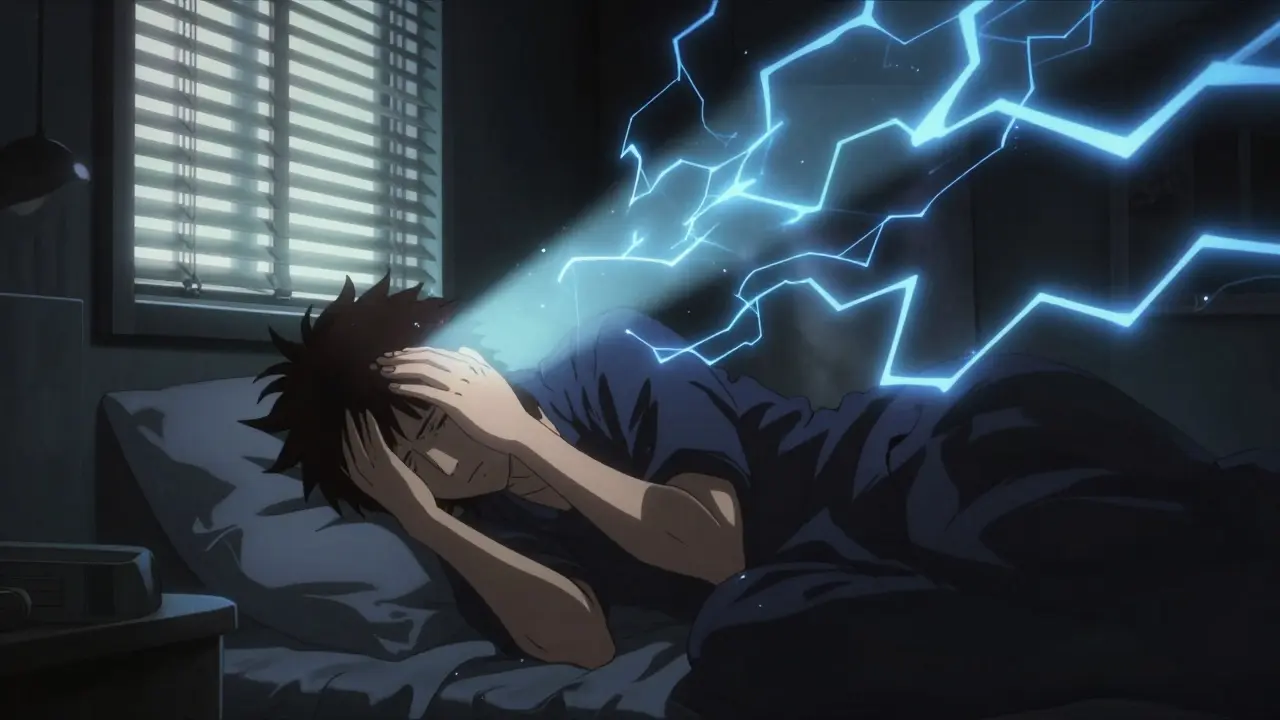
Misdiagnosis is rampant. A 2021 Mayo Clinic study found that up to 50% of headache cases are initially misdiagnosed. Why does this happen? Because symptoms can overlap. For instance, some migraine patients experience autonomic features like tearing eyes, leading doctors to falsely diagnose cluster headaches. Dr. Shivang Joshi, a headache specialist, notes that "it's not unusual for migraine patients to also have [autonomic features]... They might go to the emergency room, and they falsely diagnosed with cluster headache when it's not." To help you differentiate, here is a comparison of key attributes:
| Feature | Tension-Type Headache | Migraine | Cluster Headache |
|---|---|---|---|
| Pain Quality | Pressure-like, squeezing, "vice-like" | Pulsating, throbbing | Excruciating, stabbing, orbital |
| Location | Bilateral (both sides) | Often unilateral (one side), but can be bilateral | Strictly unilateral (one side) |
| Duration | 30 minutes to 7 days | 4 to 72 hours | 15 to 180 minutes |
| Associated Symptoms | None or mild sensitivity to light/sound | Nausea, vomiting, photophobia, phonophobia, aura | Tearing, red eye, runny nose, drooping eyelid, restlessness |
| Activity Impact | Not aggravated by routine physical activity | Aggravated by activity; patient seeks stillness | Patient paces and cannot sit still |
| Frequency | Episodic or chronic (daily) | Variable, often weekly | 1-8 per day during cluster periods |
Notice the critical difference in behavior: migraine sufferers hide in the dark; cluster headache sufferers pace the floor. This behavioral clue is often more diagnostic than the pain description itself.
Getting the right diagnosis isn’t just about comfort; it’s about economic and health outcomes. Migraines alone cost the US economy $36 billion annually in direct medical costs and lost productivity, according to a 2022 Journal of Headache and Pain study. When patients are misdiagnosed, they waste money on ineffective treatments and lose more time due to prolonged suffering.
For example, if you treat a cluster headache with ibuprofen, you will fail. If you treat a migraine with oxygen therapy, you will fail. Each condition requires a specific pharmacological approach:
Recent advancements have improved options. In 2023, the FDA approved atogepant (Qulipta) for cluster headache prevention, marking the first oral CGRP receptor antagonist for this indication. Clinical trials showed a 71% reduction in weekly attacks compared to placebo. This highlights how specialized treatment can dramatically improve quality of life.

Your doctor needs data, not just descriptions. Memory is unreliable, especially when you’re in pain. The American Headache Society recommends keeping a headache diary for at least four weeks before your consultation. Here’s what to record:
This log helps identify patterns. For instance, if your headaches always hit at 3 AM, it strongly suggests cluster headaches due to the hypothalamic clock mechanism. If they follow stressful meetings, tension headaches are more likely. This evidence allows your healthcare provider to move beyond guesswork and prescribe targeted therapy.
One major pitfall is the term "cluster migraine." Dr. Joshi clarifies that this is not a real diagnosis. Some patients experience migraines that cluster together in time, but this does not change the underlying pathology. Treating it as a cluster headache would be a mistake. Similarly, assuming all headaches are caused by dehydration or lack of sleep oversimplifies complex neurological disorders.
Another misconception is that tension headaches are "just stress." While stress is a trigger, the pathophysiology involves peripheral muscle tension and central pain modulation abnormalities. Ignoring chronic tension headaches can lead to medication overuse and worsening disability. Conversely, dismissing migraines as "just headaches" ignores the significant neurological burden and potential for progression to chronic daily headaches if untreated.
Finally, don’t ignore new or changing headache patterns. If you’ve had tension headaches for years but suddenly develop one-sided, severe pain with eye redness, seek immediate medical attention. New onset cluster headaches or changes in migraine characteristics can sometimes signal secondary causes that require imaging or further investigation.
Yes, it is possible to have both conditions, though it is rare. This is known as comorbidity. However, doctors must carefully distinguish between the two because the treatments differ significantly. A patient might have migraines for most of the year and then develop a cluster period. It is crucial to document each episode separately in a headache diary to ensure appropriate treatment for each type.
The fastest and most effective acute treatments for cluster headaches are high-flow oxygen therapy (breathing 100% oxygen through a non-rebreather mask at 12-15 liters per minute) and subcutaneous sumatriptan injections. Over-the-counter pain relievers like ibuprofen or acetaminophen are generally ineffective due to the speed and severity of the pain onset.
An episodic tension-type headache typically lasts between 30 minutes and 7 days. If you experience headaches on 15 or more days per month for at least three months, it may be classified as chronic tension-type headache, which requires a different management strategy involving preventive medications and lifestyle changes.
Nausea is present in approximately 90% of migraine attacks, making it a highly sensitive diagnostic marker. However, its absence does not rule out a migraine. Other key features include pulsating pain, sensitivity to light and sound, and aggravation by physical activity. Some migraines may present with minimal nausea but significant neurological symptoms like aura.
Cluster headaches are linked to the hypothalamus, the part of the brain that regulates circadian rhythms and sleep-wake cycles. fMRI studies show hypothalamic activation during attacks. This biological clock connection explains why attacks often occur at the same time each day or night, frequently waking patients from REM sleep. This regularity is a hallmark diagnostic feature of cluster headaches.